
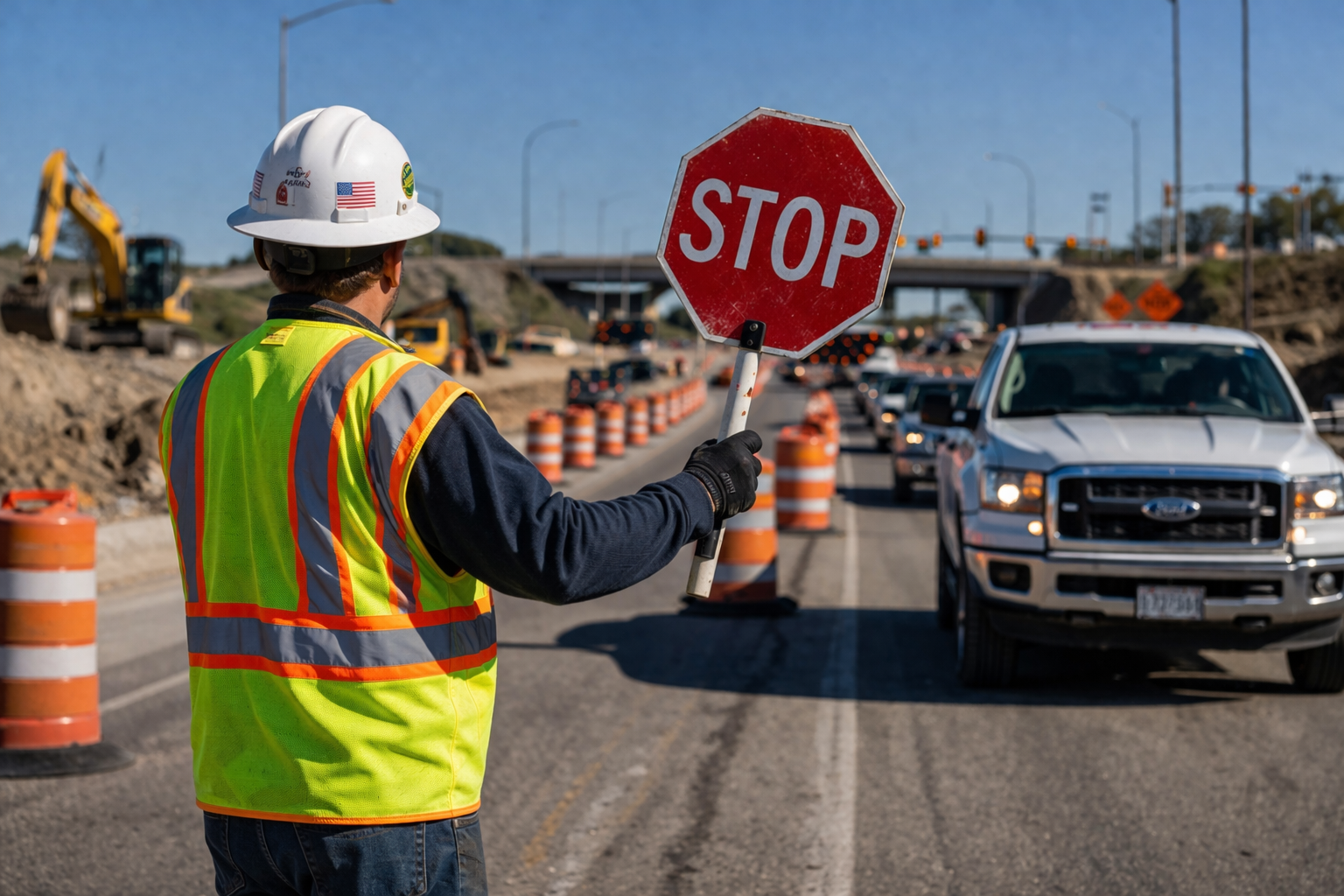
A traffic control cost estimate is a project-specific budget for the labor, equipment, phasing, compliance, and setup required to run a safe work zone. It is not just a count of cones, signs, and flaggers. A reliable estimate ties together the temporary traffic control plan, labor coverage, equipment mix, lane configuration, setup and teardown time, work hours, and contingency decisions before the first device reaches the roadway [1][2].
That matters because the compliance baseline is real, not optional. The current federal baseline for temporary traffic control is the 11th Edition with Revision 1 of the MUTCD, and Part 6 says a TTC plan should be developed for planned activities that affect road users and prepared by people knowledgeable in TTC practices [1][2]. For some federally funded work, broader transportation management planning can also apply, and that structure still includes a TTC plan at its core [3]. The federal construction safety rule also requires flagger signaling and flagger use to conform to Part 6 of the MUTCD [4].
In Illinois public-sector work, state standard specifications, supplemental provisions, and current prevailing wage schedules can materially affect labor assumptions before you ever price a single device [5][6][7]. A good estimate catches those realities early, because traffic control is usually expensive for one reason: someone assumed the field would be simpler than it actually is.
Table of Contents
What is a traffic control cost estimate and why does it matter?
A traffic control cost estimate is the cost model for keeping the work zone safe, legal, and buildable. It matters because the cheapest number on bid day often becomes the most expensive number in the field when crews lose time, closures have to be reset, or agency requirements force a redesign.
A complete estimate should answer the practical questions that show up before wheels are on the road:
- What plan governs the work zone?
- What labor and devices are required for each phase?
- When does the closure go up, and when does it come down?
- What has to stay open for side streets, driveways, pedestrians, transit, or local access?
- What changes if the job runs longer than expected, shifts to night work, or becomes an emergency response?
Part 6 makes clear that a TTC plan should start in the planning phase and continue through design, construction, and restoration, not get invented at the shoulder five minutes before setup [2]. That is why good estimating is really risk control. It protects margin, schedule, and compliance while also reducing the wider delay, vehicle operating, crash, and emissions costs that work zones can push onto the public when traffic is handled poorly [8].
What factors affect the cost of traffic control on a project?
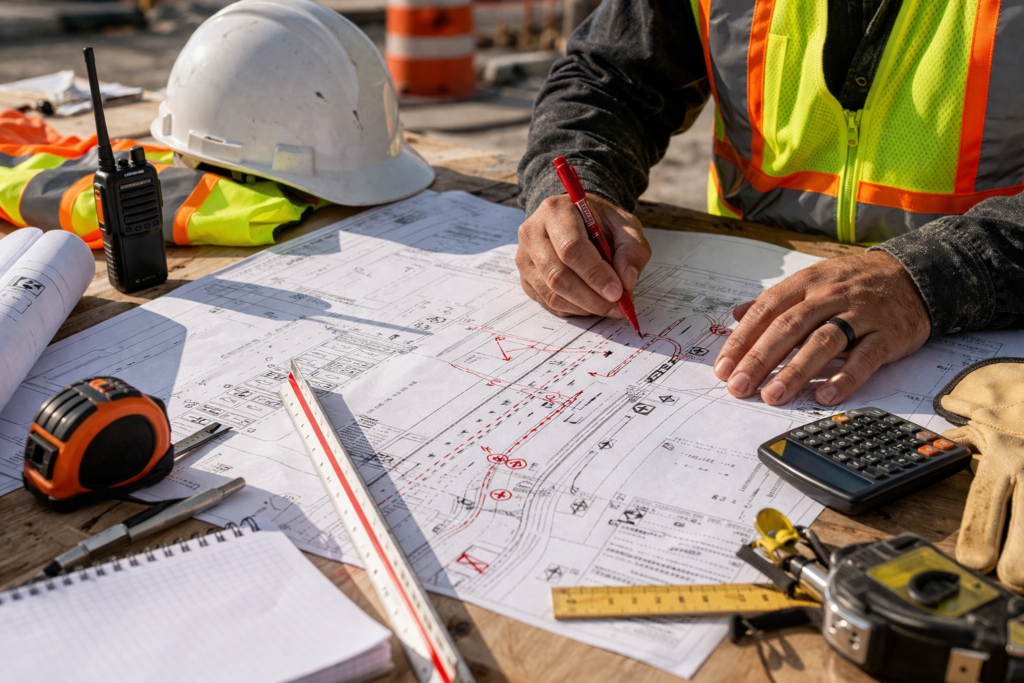
Traffic control cost is driven mainly by project duration, roadway complexity, traffic exposure, access needs, device mix, and agency requirements. The more moving parts a work zone has, the more the estimate has to carry.
| Factor | Impact on Cost | Why it Matters |
|---|---|---|
| Duration | High | More days usually means more labor coverage, more inspections, more maintenance, and more chances for schedule drift |
| Hours of work | High | Night work, weekends, and off-peak lane closures often change staffing, response time, and setup windows |
| Roadway type | High | Intersections, arterials, bridge approaches, and one-lane roads do not require the same control methods |
| Traffic volume | High | Heavier volume increases queue risk, delay exposure, and the need for more disciplined phasing |
| Access needs | Medium to high | Side streets, businesses, driveways, transit, and pedestrians increase layout complexity |
| Device mix | Medium to high | Flaggers, AFADs, portable signals, message boards, and barriers change both labor and equipment costs |
| Agency rules | High | Public work specifications, permitted hours, and wage requirements can materially change labor assumptions |
| Phase changes | High | Every reset, relocation, and stage change adds time, risk, and supervision |
Two Illinois-specific details are easy to miss. First, current public-work wage schedules can materially change labor cost depending on county and classification [7]. Second, where the applicable recurring special provision is in play, flaggers are required only when workers are present, which can change how you estimate standing coverage versus active work coverage [6]. Missing either one can throw off the entire budget.
How do labor, equipment, and duration impact pricing?
Labor, equipment, and duration usually control the price faster than anything else. Short jobs often feel equipment-light but become labor-heavy. Longer one-lane operations can justify more equipment if that choice reduces repeated daily setup, worker exposure, or idle time at the closure.
Simple cost breakdown: The safest way to think about pricing is to separate wage benchmarks, equipment structure, and field execution.
| Cost element | How it is commonly budgeted | What changes the number |
|---|---|---|
| Flagger labor | Hourly coverage, plus payroll burden, supervision, travel, and overtime | County wage rules, after-hours work, crew size, shift length |
| Equipment | Day, week, or month rental structure, or owned equipment allocation | Device type, job duration, delivery, pickup, maintenance, support |
| Setup and teardown | Mobilization and removal labor | Number of phases, distance between sites, traffic windows, staging changes |
| Emergency work | Premium response and compressed scheduling | Nights, weekends, same-day dispatch, utility coordination, public pressure |
Illinois occupational wage data for crossing guards and flaggers shows hourly benchmarks of about $15.27 on the low end, $19.19 at the median, and $25.98 on the high end [9]. Those figures are helpful starting points, but they are wage benchmarks, not full billed traffic control rates. Actual invoiced labor typically includes burden, travel, supervision, overtime, after-hours premiums, and any applicable public-work wage requirements [7][9].
AFADs can also change the labor model, but not every site qualifies for the same staffing approach. Current Part 6 language allows a single flagger to operate two AFADs only when the operator has unobstructed views of both devices and of approaching traffic in both directions [2][10]. That is a useful opportunity on the right job, not a shortcut you assume everywhere.
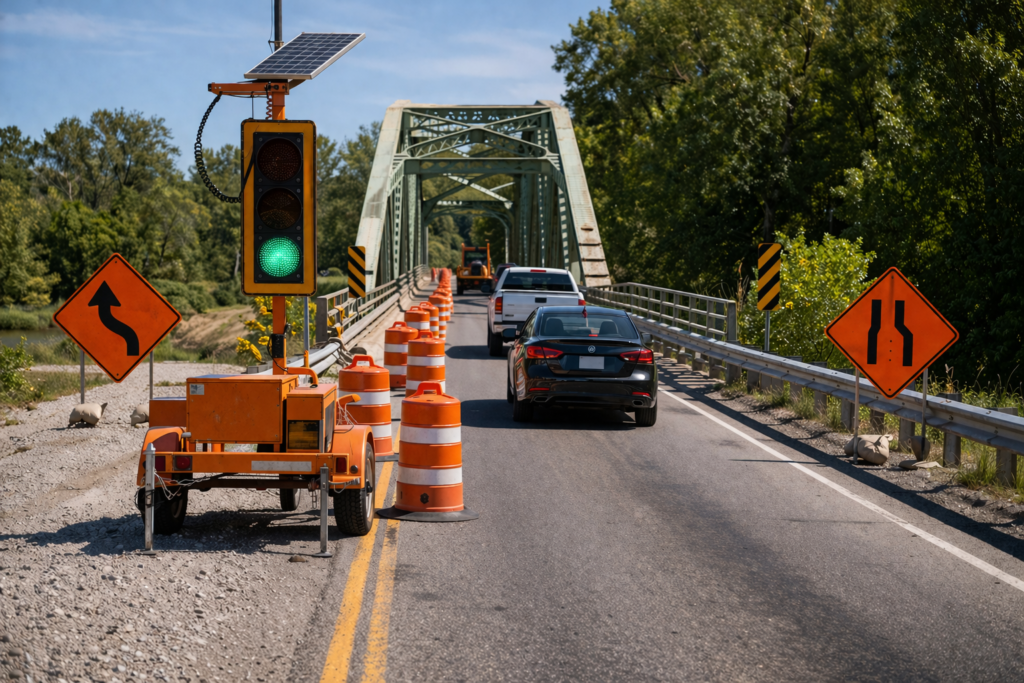
Equipment can shift the structure of the estimate. Portable signals and similar systems are commonly handled through rental programs or equipment allocations tied to the project length, with delivery, pickup, and support often becoming part of the real cost picture [11][12].
How do lane closures, road types, and traffic volume change costs?
Lane closures, roadway type, and traffic volume change cost because they change how much control the site needs and how much delay the public will tolerate. A quiet rural one-lane closure and a busy urban arterial closure are not the same estimating problem.
Typical pattern: The more conflict points a site has, the more the estimate should carry for traffic control.
- Rural two-lane road: Often simpler in device count, but sight distance, queue control, and one-lane operations still drive the method selected.
- Urban arterial or intersection: Cost usually rises because side streets, turning movements, pedestrians, driveways, and business access all add complexity.
- Long-duration or repeated operations: Portable signals can make more sense when the same control pattern would otherwise be reset over and over.
- Night work: Temporary traffic control signals are often preferable to repeated flagging on long-term jobs and activities that would otherwise require flagging at night [2].
- High-volume corridor: Delay exposure becomes a real cost issue, not just an inconvenience issue [8].
Part 6 lays out the design factors that complicate temporary signal applications, including safety needs, staging, sight distance, traffic volume, speed, affected side streets and driveways, pedestrians, adjacent land uses, and inspection and maintenance needs [2]. In plain English, that means road type and traffic conditions do not just change how many devices you need. They change how carefully the entire closure has to be designed, timed, monitored, and maintained.
That is also why underestimating traffic impact can be more expensive than overestimating a few devices. Work zone road user cost includes delay, vehicle operating costs, crash costs, and emissions costs [8]. On the wrong roadway, a cheap traffic control plan can become an expensive project outcome.
What are the most common mistakes when estimating traffic control?
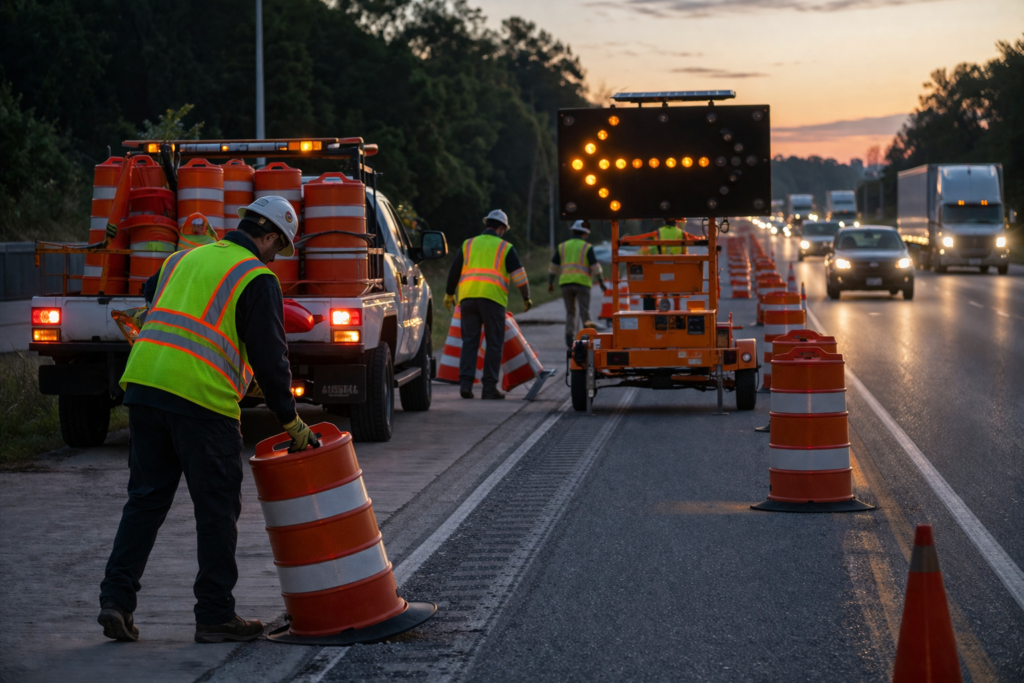
Most bad estimates fail before the first cone goes out. They fail because the estimator priced a device list instead of a real work zone operation.
Common misses:
- Pricing signs and cones, but not the labor to place, inspect, reset, and remove them
- Underestimating how long the work actually takes once traffic windows and setup time are included
- Ignoring side streets, driveways, school routes, pedestrian circulation, or transit impacts
- Assuming the day setup and the night setup cost the same
- Treating prevailing wage, permit constraints, or public-work provisions as someone else’s problem
- Assuming a site can use a more aggressive equipment or staffing method without checking geometry and visibility requirements
- Choosing the lowest-cost option without asking who maintains the setup if devices shift, batteries weaken, weather changes, or queues back up
A second mistake is failing to separate wage benchmark from bill rate. Labor is not just the hourly pay line. It is also supervision, burden, travel, fleet time, communication, and the cost of standing ready when production falls behind. A third mistake is pricing a generic closure instead of pricing the actual phasing sequence the crew will live with. Traffic control rarely breaks the budget all at once. It leaks the budget away through resets, extensions, idle windows, and field corrections.
How can contractors reduce traffic control costs without sacrificing safety?
The safest way to reduce cost is to remove waste, not protection. Smart savings come from tighter planning, fewer resets, better device selection, and fewer surprises once the closure is live.
Cost control moves that usually help:
- Match closure windows to real production instead of defaulting to broad, open-ended work hours
- Reduce unnecessary phase changes and relocations that force repeated setup and teardown
- Walk the site early so driveway conflicts, bus stops, pedestrian paths, and sight-distance issues do not become change-order problems
- Verify wage assumptions and public-work requirements before the bid goes out [6][7]
- Reserve equipment early when rentals, delivery windows, and support availability matter [11]
- Use the right device mix for the job instead of forcing manual flagging into every situation
- Consider portable signals or AFADs where the geometry, duration, and approval path support them [2][10][12]
- Use remote monitoring when repeated status checks would otherwise create extra trips and extra labor [12][13]
The practical goal is simple: reduce unnecessary worker exposure and unnecessary field touches. If a closure can be run more consistently with the right equipment, fewer daily changes, or better monitoring, the estimate often improves without giving up safety. That balance matters because traffic control is one of the few bid items where a bad cost decision can increase both direct project cost and public-facing delay cost at the same time [8].
What should you expect from a professional traffic control provider?
You should expect a provider to do more than drop equipment at the curb. A strong provider helps translate scope into a safer, more predictable operating plan.
At minimum, expect these basics:
- A clear review of scope, phasing, hours, roadway type, and access constraints
- A quote that states assumptions instead of hiding them
- Device recommendations that fit the site, not just what happens to be available
- Delivery and pickup planning, plus support expectations, before the job starts
- A maintenance and response plan for damaged units, battery issues, weather, or shifting field conditions
- Real guidance on whether portable signals, AFADs, or manual control make the most sense for the work zone
- Support for longer or more complex jobs where monitoring, controller access, or rapid troubleshooting matter [11][12][13]
That last point is often where the best estimates separate themselves. If a provider can support rentals with delivery, pickup, and expert assistance, and if portable signals can be monitored or programmed remotely when the project calls for it, the estimate becomes more predictable because the operational plan is more predictable [11][12][13].
Bottom line: A strong traffic control cost estimate protects far more than a budget. It protects schedule, compliance, worker exposure, and public confidence. If your team is pricing a one-lane closure, portable signal rental, or AFAD deployment, getting the scope reviewed before bid day usually costs less than fixing an undersized plan after traffic is live [2][11][12].
FAQ section:
How much does traffic control cost per day? Daily traffic control cost depends on labor coverage, closure complexity, equipment type, shift timing, and any prevailing-wage or emergency-response requirements. Short daytime jobs are often labor-heavy, while longer one-lane operations may justify more equipment and fewer repeated field visits [7][9][11][12].
What is included in a traffic control setup? A complete setup usually includes the plan, advance warning signs, channelizing devices, any required flaggers or temporary signals, mobilization, inspection, maintenance during the shift, and removal [2][3].
Do I need a traffic control plan for every project? Planned activities that affect road users should have a TTC plan under Part 6, and some federally funded projects require the broader TMP structure as well [2][3].
Key Takeaways
- A traffic control cost estimate should price the whole operation, not just devices on a list.
- Labor assumptions change quickly when duration, public-work wage rules, and shift timing change.
- Lane closures on higher-volume or more complex roads usually justify more planning and tighter device selection.
- The best savings usually come from fewer resets, better phasing, and the right equipment, not from underbuilding the work zone.
- JTI Traffic Control can help you build an accurate traffic control cost estimate before your next project
References
Standards and rules
[1] Manual on Uniform Traffic Control Devices home page, confirming the current official edition is the 11th Edition with Revision 1, effective March 5, 2026.
[2] Manual on Uniform Traffic Control Devices, Part 6, covering TTC plans, worker safety, temporary traffic control signals, and AFAD operating conditions.
[3] Transportation Management Plans for Work Zones fact sheet, explaining when broader work zone planning includes a TTC plan.
[4] Federal construction safety signaling standard requiring flagger signaling and flagger use to conform to Part 6 of the MUTCD.
Costs and labor
[5] Illinois standard specifications page for road and bridge construction requirements.
[6] Illinois supplemental specifications document containing the recurring special provision stating that flaggers are required only when workers are present where that provision applies.
[7] Illinois current prevailing wage rates page for public works projects.
[8] Work zone road user costs guidance covering delay, vehicle operating, crash, and emissions costs.
[9] Illinois statewide wage publication showing occupational wage benchmarks for crossing guards and flaggers.
Equipment and operations
[10] Automated flagger assistance device overview describing AFAD use and worker exposure reduction context.
[11] Rental program page describing delivery, pickup, and expert support for portable traffic control equipment rentals.
[12] Portable traffic signals page covering applications, equipment options, and monitoring availability.
[13] Remote management system page describing real-time monitoring and programming functions for portable traffic signals.