
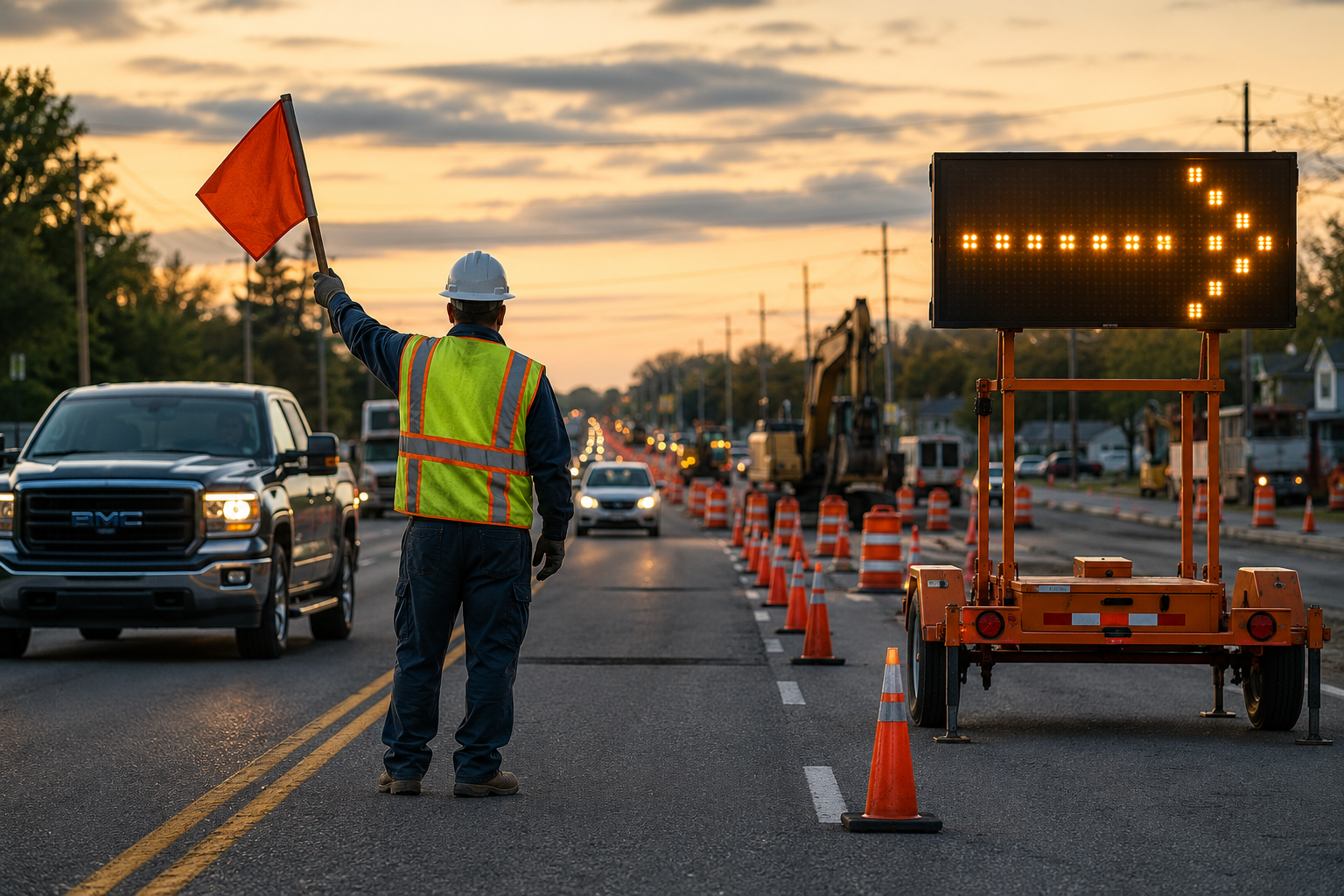
If you are asking how much does traffic control cost, the answer depends on the jobsite, including labor, equipment, project duration, roadway type, traffic volume, setup, teardown, compliance needs, and emergency or after-hours work. A custom quote is usually the only accurate way to price a real work zone because no two closures, roads, or project schedules are exactly the same.
Traffic control is not just a line item for cones and signs. It is the planning, labor, equipment, coordination, inspection, and field response needed to move drivers, pedestrians, and workers safely through or around a jobsite. Current federal standards recognize the 11th Edition with Revision 1 as the current official edition, and Part 6 focuses on temporary traffic control for road users and workers in active work areas [1][2]. Federal construction signaling rules also connect flagger use to Part 6 requirements [3].
For many public projects, traffic control can also be part of a broader transportation management plan, especially when the work affects road users in a meaningful way [4]. That is why the cheapest bid is not always the lowest cost. Poor traffic control planning can create delays, crew downtime, public complaints, rework, and road user costs that are not obvious when an estimate is first built [5].
Table of Contents
How much does traffic control cost for a construction project?
Most construction traffic control costs are project specific because the setup has to match the road, the work, and the risk. A short daytime shoulder closure may have a different cost structure than a multi-day lane closure, a one-lane bridge operation, an emergency utility repair, or a high-volume urban intersection.
The best way to think about pricing is by scope, not by guessing a universal daily rate. A provider has to know where the work is, when it will happen, how traffic will move, what devices are needed, how many workers are exposed, and how often the setup will need to change.
Practical answer: Traffic control pricing usually changes based on:
- Project duration
- Roadway type
- Traffic volume
- Lane closure complexity
- Number of flaggers or crew members required
- Equipment needed
- Setup and teardown time
- Permits or agency requirements
- Prevailing wage requirements where applicable
- Emergency response or after-hours work
- Weather, access, staging, and phasing complexity
That is why two jobs with the same device count can still price very differently. One may require simple daytime placement with easy access. Another may require night work, multiple mobilizations, tighter lane widths, pedestrian routing, or a more complex closure sequence.
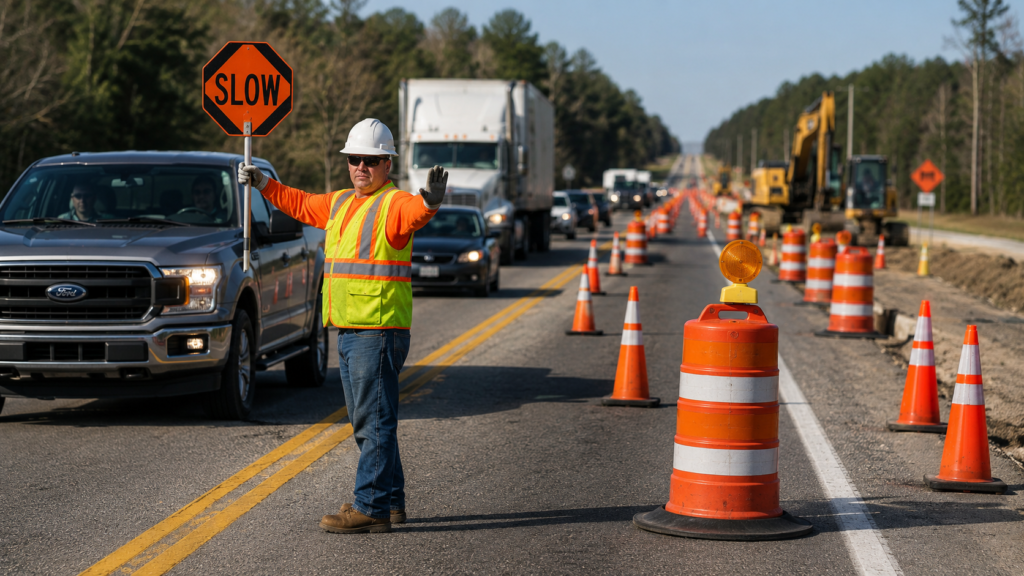
What factors affect traffic control pricing?
Traffic control pricing is affected by exposure, duration, access, labor, equipment, and compliance requirements. The more complex the site, the more the budget needs to account for setup time, maintenance, and field adjustments.
| Factor | How It Affects Cost | Why It Matters |
|---|---|---|
| Labor coverage | More workers or longer shifts increase cost | Flagging, setup, teardown, and inspection all require time |
| Project duration | Longer jobs require more coverage and maintenance | Multi-day work can change whether labor or equipment is more efficient |
| Roadway type | Intersections, bridges, and arterials raise complexity | Traffic flow, access points, and sight distance can change the setup |
| Traffic volume | Higher volume can require tighter phasing and more control | Queue risk and public delay become bigger concerns |
| Equipment needs | Signals, AFADs, arrow boards, and message boards change pricing | The right device mix can reduce labor or improve control |
| Setup and teardown | Repeated mobilization adds labor and truck time | Every phase change has a cost |
| Night or weekend work | After-hours work often changes staffing and response needs | Limited windows can increase pressure on setup speed |
| Agency requirements | Specifications, inspection, permits, and wage rules can affect pricing | Public work requirements can change the estimate before the job starts |
In public-sector work, wage requirements can also affect labor assumptions. In Illinois, current prevailing wage schedules are published for public works and can change the labor side of a traffic control budget depending on location and classification [6]. For contractors, that means the same work zone may not carry the same labor cost in every county or under every project type.
What is usually included in traffic control services?
A complete traffic control services quote should show what planning, labor, devices, delivery, monitoring, and removal are included. The exact scope depends on the project, but a complete quote should make clear what is included and what assumptions were used.
A realistic traffic control services cost may include:
- Planning and coordination before the job starts
- Review of closure needs, phasing, access points, and work hours
- Temporary traffic control setup
- Flaggers or crew support where needed
- Cones, drums, signs, barricades, arrow boards, or message boards
- Portable traffic signals or AFADs where appropriate
- Delivery and pickup of equipment
- Monitoring, inspection, or maintenance during the project
- Teardown and removal after the work is complete
Scope matters: A low number may look attractive if it leaves out delivery, pickup, after-hours support, device maintenance, or extra phase changes. A better quote explains the full operating plan so contractors can compare pricing fairly.
The biggest mistake is treating traffic control setup cost as a one-time drop-off. On many jobs, the cost is tied to how often devices need to be moved, how long crews must remain on site, how traffic responds, and whether the setup needs active support during the shift.
How much do flaggers, lane closures, and equipment affect the final price?
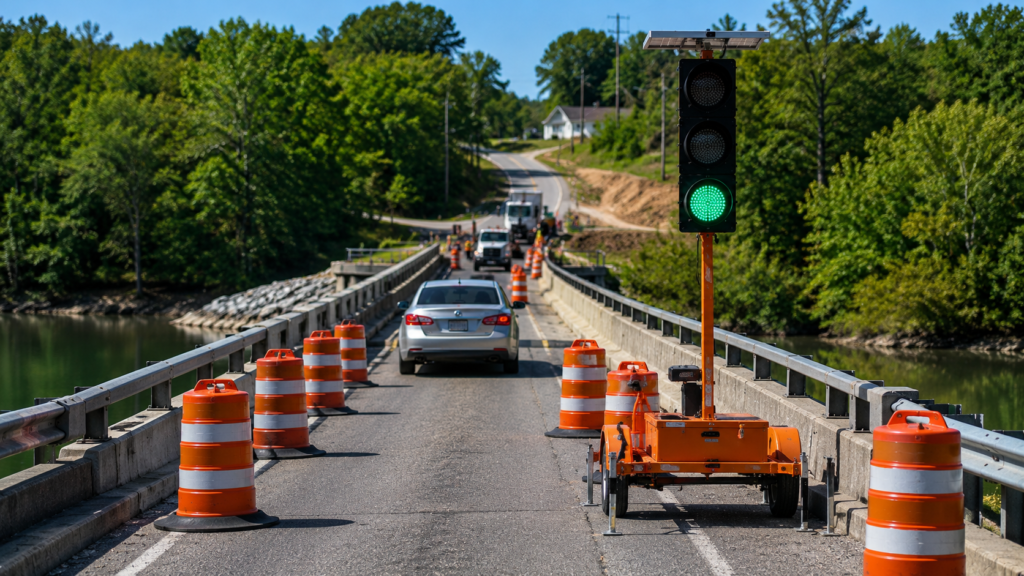
Flaggers, lane closures, and equipment affect the final price because they control how much labor is needed and how long the work zone stays active. A labor-heavy setup may be practical for short-duration work, while a longer operation may be better served by equipment that reduces repeated field exposure.
Flaggers: Flagger coverage can be a major cost driver because it is time based. The estimate should account for shift length, crew size, travel, setup, teardown, supervision, overtime, and any public-work labor requirements. The phrase flagger cost per hour can be useful for search, but the actual billed cost usually depends on much more than a wage number.
Lane closures: A lane closure cost depends on the roadway, hours of work, lane configuration, traffic volume, access points, and whether the closure has to be removed and reset each day. Closures on high-volume roads usually require more planning because they can create larger delay and queue impacts [5].
Equipment: Traffic control equipment cost depends on the device type and how long it is needed. Cones and drums are different from arrow boards, portable traffic signals, message boards, AFADs, or remote monitoring tools. AFADs can also change how workers are positioned by allowing operation from the roadside in appropriate applications [7][8].
Simple comparison: A short utility repair may rely mostly on flaggers and basic channelizing devices. A longer one-lane closure may justify portable signals or AFADs if the site conditions, approval path, and duration support that approach. The lowest daily price is not always the lowest total project cost if it creates repeat mobilization, added downtime, or more worker exposure.
Why do emergency, night, or weekend setups cost more?
Emergency, night, and weekend setups usually cost more because they compress planning time and require harder staffing. Rush work can also limit equipment choices, increase travel pressure, and reduce the ability to optimize the closure before crews arrive.
Common reasons costs rise:
- Rush scheduling with limited planning time
- Emergency response after normal business hours
- Night work with tighter closure windows
- Weekend or holiday staffing needs
- High-volume roadways with limited allowable work periods
- Complex intersections or multiple access points
- Multiple phases or repeated mobilization
- Poor planning before the job starts
Night work can be especially sensitive because visibility, driver behavior, worker exposure, and setup timing all matter. A job that looks simple during the day may require more deliberate device placement, lighting coordination, inspection, and communication once work moves into off-peak hours.
Poor planning is another hidden cost driver. If the closure is not matched to real production, crews may spend paid time waiting for the setup to change. If access points are missed, devices may have to be moved. If equipment is reserved late, the available option may not be the most efficient one. These are the kinds of issues that turn temporary traffic control pricing into a schedule problem.
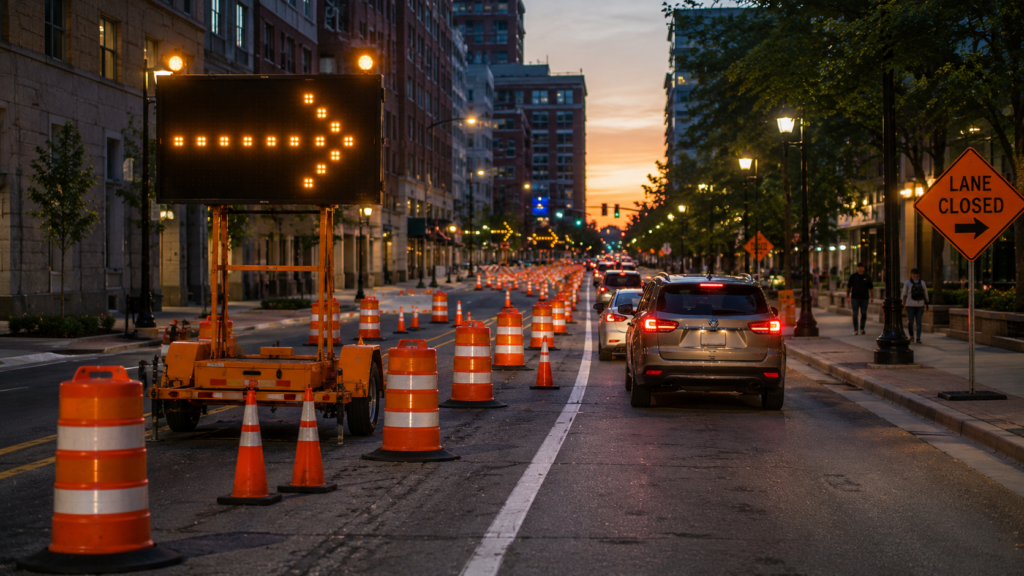
Is it cheaper to use flaggers or portable traffic signals?
Neither option is automatically cheaper because the better choice depends on duration, road type, visibility, traffic volume, and worker exposure. Flaggers may be more efficient for short, simple, active work, while portable signals or AFADs may make sense for longer or repeated one-lane operations.
Labor-heavy setup: This can work well when the job is short, the closure is active, sight distance is manageable, and crews need flexible control. The cost is tied closely to hours, staffing, and how often the setup has to be repeated.
Equipment-supported setup: Portable traffic signals, AFADs, and remote monitoring tools can change the cost structure. They may reduce certain labor needs, improve consistency, or support longer-duration control patterns when the site is appropriate. Rental programs can include delivery, pickup, and expert support, which should be considered as part of the total project cost [9]. Portable traffic signals may also be paired with remote monitoring features that help teams track signal status and traffic conditions [10][11].
The right answer is usually not “Which one is cheapest today?” It is “Which setup gives the safest, most reliable control for the full project?” If the wrong method causes delays, extra mobilization, or field corrections, the apparent savings can disappear quickly.
How can contractors lower traffic control costs without cutting safety?
Contractors can lower traffic control costs by planning early, reducing unnecessary field changes, and matching the control method to the actual work. The goal is to remove waste, not remove protection.
Cost control moves that usually help:
- Share accurate project details before pricing
- Request a traffic control cost estimate before bidding
- Choose work windows that match real production
- Reduce unnecessary phase changes
- Review driveways, sidewalks, side streets, and access points early
- Match equipment to the roadway and duration
- Reserve specialized equipment before the project is urgent
- Avoid last-minute changes when possible
- Confirm wage, permit, and agency requirements before work starts
A cleaner scope usually creates a cleaner price. When the provider knows the dates, work hours, road type, closure needs, and expected duration, they can recommend a setup that fits the job instead of guessing. That helps control labor, equipment, delivery, teardown, and support needs.
Smart savings: The best savings often come from fewer resets, fewer wasted trips, and fewer surprises. Cutting devices without understanding the traffic risk can create bigger costs later. Better phasing, better timing, and better information are usually safer ways to manage the budget.
When should you request a custom traffic control quote?
You should request a custom quote as soon as the project scope, location, work hours, and closure needs are clear enough to review. Waiting until the last minute can limit equipment availability, raise labor pressure, and leave less time to solve access or staging issues.
Before requesting a quote, gather:
- Project location
- Planned dates and work hours
- Road type and number of lanes
- Lane closure or shoulder closure needs
- Expected project duration
- Traffic volume or known restrictions
- Site plans, drawings, or sketches
- Agency, permit, or inspection requirements
- Whether the work is planned or emergency response
- Any pedestrian, driveway, business, school, or transit access concerns
That information helps a traffic control provider build a quote around real field conditions. It also helps contractors avoid underpricing the job during bidding and then finding out later that the closure requires more devices, more labor, or a different phasing plan.
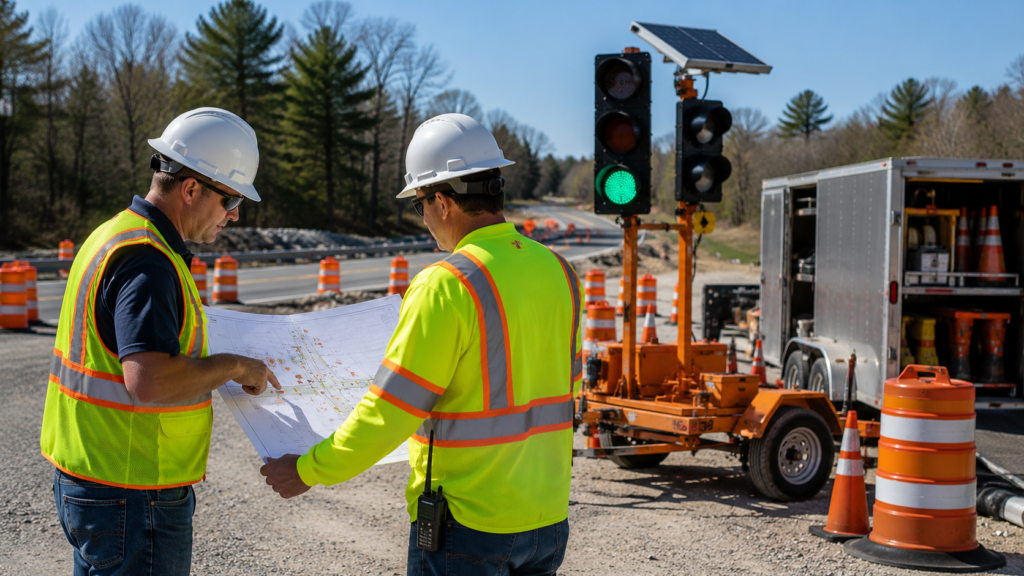
FAQ:
- What is the average traffic control cost per day? There is no universal average traffic control cost per day because labor, roadway type, equipment, duration, and closure complexity vary by project. A short active work zone and a multi-day one-lane operation can have very different cost structures.
- Why does traffic control pricing vary so much? Pricing varies because every site has different traffic exposure, access needs, work hours, staging limits, device requirements, and compliance considerations. A realistic quote has to price the full operation, not just the visible devices.
- How do I get an accurate traffic control quote? Provide the location, dates, work hours, road type, closure needs, expected duration, plans or drawings, and any agency requirements. The more accurate the project information is, the more useful the quote will be.
Ultimately, the best answer to how much does traffic control cost is this: it costs what the work zone requires to operate safely, efficiently, and in line with the project scope. Accurate pricing depends on real jobsite details, not a generic number. Smart planning protects budget, schedule, worker safety, and public movement. JTI Traffic Control can help review your project needs and support pricing or planning before the job starts.
Key Takeaways
- Traffic control pricing is project specific because labor, equipment, duration, roadway type, and compliance needs all affect cost.
- The cheapest setup is not always the lowest total cost if it creates delays, extra mobilization, or more worker exposure.
- Contractors can control cost by planning early, sharing accurate details, and reducing unnecessary phase changes.
- A custom quote is the best way to budget traffic control before bidding or scheduling work.
- JTI Traffic Control can help contractors review project needs before the work zone goes live.
References
Standards and planning
[1] Current MUTCD edition page confirming the 11th Edition with Revision 1 as the current official publication.
[2] MUTCD Part 6 covering temporary traffic control principles, road user needs, and work zone control practices.
[3] Construction signaling standard requiring flagger signaling and flagger use to conform to Part 6 of the MUTCD.
[4] Transportation management planning fact sheet explaining work zone planning and TTC plan context.
Costs and labor
[5] Work zone road user cost guidance covering delay, vehicle operating, crash, and emissions cost categories.
[6] Illinois current prevailing wage rates page for public works labor cost context.
Equipment and operations
[7] Automated flagger assistance device overview describing AFAD use and worker exposure reduction context.
[8] AFAD equipment page describing roadside remote operation and compact trailer features.
[9] Rental program page describing portable traffic signal rentals, delivery, pickup, and expert support.
[10] Portable traffic signals page covering applications, equipment options, and remote monitoring availability.
[11] Remote management system page describing real-time monitoring, alerts, and direct-to-controller programming.