

A lane closure can fail for reasons that have nothing to do with the work itself. The most common breakdown is a plan that clears review but cannot be built consistently in the field, especially under tight windows, variable traffic behavior, and changing weather. This 2026 playbook is designed to help Illinois teams build a visibility-first temporary traffic control plan (TCP) that is review-ready, buildable, and easier to maintain across every shift. [1][3][4]
You will find practical decision cues, a comparison of documentation approaches, a compact change-control flow, and a checklist table you can hand to estimators, project managers, and field leaders. The goal is fewer rejections, fewer field resets, and fewer rework events caused by plan-field mismatch. [4][5]
Table of Contents
Why Do Illinois Contractors Need a Traffic Control Plan Before Bidding?
The bid phase is where most lane closure risk gets priced correctly or priced into a future problem. A traffic control plan is not only a compliance deliverable. It is a scope definition that drives quantities, labor, equipment, production windows, and contingency. [4][5]
Bid accuracy: A plan forces you to quantify what you will actually install and maintain. Without that, it is easy to underestimate device counts, protective vehicle needs, inspection labor, and the time required for setup and closeout. Those misses tend to show up as schedule compression, safety exposure, or both. [1]
Schedule realism: Review and approval cycles, staging restrictions, and permitted work hours can shape the schedule more than the work activity. A bid that assumes unlimited lane time can be correct on production but wrong on operations, which is how projects end up chasing the clock on every closure. [3][4]
Risk control: When a closure is complex, it is cheaper to solve the geometry on paper than to solve it live. A plan gives you a way to identify high-risk access points, pedestrian conflicts, queue potential, and night visibility needs while you still have options. [2][6]
If you want one practical rule for estimating: price the plan you can actually build, inspect, and close out every night, not the plan you wish you could build on a perfect shift.
What Is a Temporary Traffic Control Plan and When Do Illinois Projects Need One?
A temporary traffic control plan is a documented strategy for guiding road users through or around a work area while protecting workers, equipment, and the public. Depending on the job, it may be a standalone plan sheet, a series of stages, a set of typical layouts with job-specific edits, or a component inside a broader work zone management package. [1][4]
What it covers: The plan addresses how traffic is warned, transitioned, and guided, and how the work area is separated and protected. It also covers how that setup is inspected and maintained so the field condition remains consistent with the approved intent. [1][4]
When it is needed: In practice, you should treat it as required whenever you change normal roadway operations. That includes lane closures, shoulder closures that affect lateral clearance, ramp closures, alternating traffic, moving operations, detours, and any pedestrian routing changes that create a new decision point at night or in poor visibility. Contract documents and permits often make this explicit, and the underlying standards assume the same. [1][3]
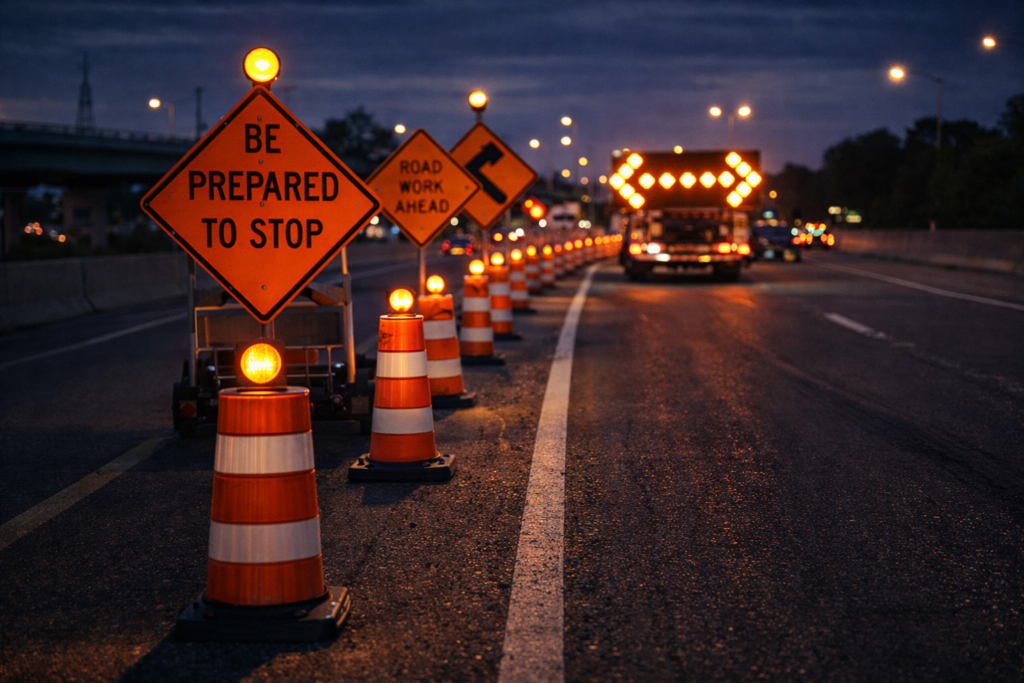
Visibility-first meaning: A visibility-first plan prioritizes early comprehension and clean sight lines. It treats retroreflective performance, glare control, device placement accuracy, and inspection frequency as core design inputs instead of afterthoughts. This is especially important in Illinois where weather and pavement conditions can change device readability quickly. [6]
What Are the Essential Parts of a Compliant TCP in 2026?
A plan becomes compliant and useful when it answers the questions a reviewer and a crew will ask. Reviewers need consistency and clear intent. Crews need build steps, quantities, and triggers for what to do when conditions change. [1][4]
Core elements: Most field-ready plans include the same building blocks, even when the layout varies.
- Limits and context: exact begin and end points, direction of travel, and nearby ramps, intersections, or access points that change driver behavior. [1]
- Stage logic: how the traffic pattern changes across stages, what triggers the next stage, and what the roadway looks like at each stage. [4]
- Advance warning sequence: sign order, placement logic, and special conditions (curves, hills, side streets, low lighting). [1]
- Transition and taper details: taper type, length basis, and device spacing logic that crews can replicate. [1]
- Buffer and workspace: how separation is maintained, and what is prohibited inside the buffer. [1]
- Protection strategy: how the most exposed work and setup activities are protected, including where protective vehicles sit and how they move. [6]
- Access and local movements: how driveways, ramps, and business access are handled without creating surprise conflicts. [3]
- Pedestrian routing: detour geometry, separation, nighttime visibility, and detectable edges where applicable. [1]
- Night addendum: lighting approach, glare control, device brightness, and added inspection triggers for wet pavement and reduced contrast. [2][6]
- Inspection and maintenance: opening checks, rolling checks, trigger checks, and the documentation method that proves control is active. [4][5]
- Change control: what can be adjusted in the field, what must be escalated, and what documentation is required to resume work. [4]
- Closeout: device removal order, verification drive-through, and lessons-learned capture for the next closure. [6]
Mini-summary: A compliant plan is not only a drawing. It is a repeatable operational system with a layout, a build sequence, an inspection routine, and a change-control process. [4][5]
How Do You Select the Right Typical Application and Still Make It Site-Specific?
Typical layouts are valuable because they standardize proven patterns. The mistake is treating them as finished plans rather than starting points. Geometry, access points, posted speeds, truck percentages, and pedestrian needs can make a typical layout incomplete if it is not adapted. [1][3]
Site-specific reality check: Before you finalize any typical layout, verify the assumptions behind it. A curve changes sight distance. A ramp changes decision timing. A high driveway density changes where conflicts actually happen. A narrow shoulder changes where equipment can stage without encroaching. [1]
Buildability test: Ask one question the crew can answer in two minutes: “Can we install this in the allotted time, in the dark or rain, using the devices listed, without improvising?” If the answer is no, the layout is not finished. [6]
Use this comparison to choose how you document and submit your plan.
| Documentation approach | Where it works best | Common risks | Practical mitigations |
|---|---|---|---|
| Typicals-only | Simple, short-duration work with few access points | Assumptions do not match field; missing local moves; weak night details | Add site notes, limits, and device quantities; include a night addendum and inspection triggers |
| Site-specific plan sheets | Complex closures, ramps, intersections, high public exposure | Higher effort; more review time; risk of over-detailing without clear build steps | Use a standard template, include a build sequence, and keep quantities and notes consistent |
| Hybrid typical plus job edits | Most Illinois lane closures with repeatable patterns | Edits are unclear; field reads only the typical and misses the modifications | Highlight edits in notes, add a device list, and include a one-page field checklist per stage |
A hybrid approach often performs best because it keeps the pattern familiar but forces you to document the site-specific risks that drive rejection and rework. [3][4]
A hybrid approach often performs best because it keeps the pattern familiar but forces you to document the site-specific risks that drive rejection and rework. [3][4]

How Do You Document Sign Sequencing, Tapers, and Device Quantities So Crews Can Build It?
Crews do not install a plan. They install a sequence. Your documentation must translate intent into a build order with quantities and placement logic that survives fatigue, weather, and shift turnover. [1][6]
Sign sequencing: A plan that only shows signs on a sheet can still be hard to build if it does not clearly communicate order and decision points. A field-friendly sequence explains what drivers see first, what they see next, and what action each sign supports. [1]
Taper documentation: Taper length and device spacing are not just numbers. They are the driver comprehension zone. When you document tapers, show the taper type, the lateral shift, the basis for length selection, and the spacing strategy so crews can rebuild it correctly after a hit or a reset. [1]
Quantities and spares: Include device counts by stage and a small spare allowance for the most failure-prone items, such as channelizers at the taper start. If the plan assumes perfection, it will fail the first time a device is displaced. [6]
A quick way to make plans buildable is to include a short field checklist for each stage that answers:
- What is the first device placed and why is it protected?
- What is the minimum setup needed before traffic can be released into the pattern?
- What is the most critical point to inspect every interval?
- What triggers a pause and escalation? [4][6]
Accessibility callout: If the work affects sidewalks, crossings, or shared-use paths, the plan must show a continuous route that is visible at night and separated from traffic and the activity area. The most common field failure is an unplanned gap where pedestrians are pushed into low-visibility conflict points. [1][6]
How Do You Plan Night Visibility and Work Zone Lighting Without Creating Glare?
Night operations magnify plan weaknesses because drivers rely on retroreflective cues, contrast, and clean sight lines. Wet pavement can double reflections, and a single poorly aimed light can hide the taper by creating a bright haze at the decision point. [6]
Night work zone lighting plan: Treat lighting as a plan element, not an equipment choice made after dark. Define where lighting is needed, what it must illuminate, and how glare will be controlled so approaching traffic is not blinded. [6]
Visibility-first night addendum: Add a short night section to each stage that addresses:
- Device retroreflective performance expectations and cleaning triggers
- Arrow board mode, aiming, and brightness control for night readability
- Lighting placement and aiming, including shielding when needed
- Extra inspection frequency under rain, fog, or reduced contrast conditions [2][6]
Glare control: In most field situations, controlled downward lighting and reduced hot spots produce safer outcomes than maximum brightness. Validate by viewing the setup from the driver approach, then adjust before production begins. [6]
When off-peak windows are used to protect capacity, the plan should still acknowledge the operational reality: tight windows increase the temptation to skip inspections, which is when visibility failures become shutdowns. [2][5]
What Are the Most Common Reasons TCP Submittals Get Rejected or Sent Back?
Most rejections are not about one wrong device. They are about missing logic, missing clarity, or missing proof that the plan can be built and maintained safely. [1][3][4]
Common rejection reasons at review, written as field-fixable actions:
- Limits are unclear: add exact begin and end points and define what the open condition looks like.
- Stages are not defined: add stage triggers and show each stage as a complete traffic pattern.
- Sign sequence is incomplete: provide order and intent, not only symbol placement. [1]
- Taper and buffer logic is missing: document taper type, length basis, and buffer use rules. [1]
- Access points are ignored: account for ramps, driveways, and local turns that will break the pattern. [3]
- Pedestrian routing is not continuous: show a complete detour with separation and night visibility. [1]
- Protection is vague: define how exposed setup and closeout work is protected and where protection sits. [6]
- Inspection and change control are absent: include an inspection routine and a simple escalation path for deviations. [4][5]
If you want to reduce resubmittals, treat the reviewer like a night foreman: they need to see a plan that can be installed and kept correct under real conditions.

How Do You Run Shift Inspections So the Field Setup Matches the Approved Layout?
A plan only reduces risk when the installed condition matches the approved intent. Shift inspections are how you keep the plan and the field aligned without relying on memory. [4][5]
Opening inspection: Before you open the closure, verify the pattern is complete and readable at the first decision point. Focus on advance warning order, taper start accuracy, device condition, and any high-risk access points. [1][6]
Rolling inspections: Set an interval that matches risk and document it. Add trigger checks after weather changes, after major equipment moves, after any device hit, and after any complaint of glare or confusion. [6]
Documentation that matters: Keep records simple enough to use. A short checklist with photo documentation of the taper start, the most critical sign, and the protection position is often more valuable than a long narrative that no one updates. [4][5]
A useful operational mindset is that inspections are not policing. They are quality control for the traffic pattern that protects your crew and your schedule.
What Changes Require Re-Approval and How Should Change Control Work in the Field?
Field conditions change. The plan should expect that and define how changes are handled without turning every adjustment into unmanaged risk. [4][5]
Two categories of change: Most plans benefit from separating adjustments into minor field adjustments and material plan changes.
Minor field adjustments are small corrections that keep the pattern consistent with intent, such as replacing displaced devices, restoring taper alignment, or adjusting device spacing within the documented strategy. Material plan changes alter the footprint, access, stage logic, or protection strategy in a way that can change driver behavior. [4]
TCP approval and field-change decision flow: Use this sequence to decide when to pause, document, or escalate.
| Step | Question or trigger | If Yes | If No |
|---|---|---|---|
| 1 | Deviation found | Go to Step 2 | Continue normal operations |
| 2 | Safety check: Is safety reduced right now (missing taper start, failed protection, glare hiding guidance)? | Pause work, restore minimum safe pattern, document, then continue only when stable | Go to Step 3 |
| 3 | Change type check: Does the change alter footprint, access, stage logic, or protection strategy? | Escalate for approval, document the change, brief crew, and re-inspect before resuming | Treat as minor adjustment, document the correction, and re-check within the next interval |
| 4 | After any change | Verify driver comprehension from the approach, then record what changed and why | |
Work zone change control process: Keep a one-page change log for each closure with time, trigger, what changed, who approved, and what verification was performed after the change. This supports consistency across shifts and strengthens compliance readiness when questions arise. [4][5]
How Do You Close Out the Work Zone and Capture Lessons Learned for the Next Closure?
Closeout is a high-exposure period because traffic is returning to normal while fatigue is rising and devices are being removed. A good plan treats closeout as a defined sequence, not an afterthought. [6]
Closeout sequence: Remove devices in reverse order so the pattern stays readable until the last step. Keep protection in place for pickup operations and avoid lighting changes that create sudden glare. [6]
Open condition verification: Include a final check that confirms no devices or signs remain that imply a false closure, and that pedestrian routes are restored or clearly routed if detours continue. [1][6]
Lessons learned: Capture what actually happened. Record what got hit, what drifted, where confusion occurred, and what adjustments improved readability. This becomes your best internal library for writing future stages faster and with fewer rejections. [5]
What Should Be on a Pre-Bid TCP Checklist for Illinois Work?
A strong pre-bid checklist helps you price the plan you can execute, not the plan that only looks good on paper. It also helps you identify when you should request a plan review before mobilization, especially on complex sites with ramps, pedestrian conflicts, or night visibility constraints. [3][4]
Pre-bid checklist mindset: The checklist is not only for estimating. It is the same checklist you will use to validate submittals, brief crews, and keep the field setup aligned with the approved intent.
Use this table as the backbone for your estimating, submittal, and field execution workflow.
| Phase | What to confirm or produce | Review-ready checks | Field-ready checks | Owner | Record |
|---|---|---|---|---|---|
| Pre-bid | Identify closure type, staging, constraints, and access impacts; estimate device quantities and protection needs | Match assumptions to contract and permit constraints | Validate buildability under the proposed window | Estimator/PM | Pre-bid TCP checklist |
| Drafting | Create stage layouts, sign sequence, taper and buffer logic, and device lists | Consistency across sheets and notes; clear limits and stages | Sequence is buildable and inspectable | Traffic control lead | Draft plan set |
| Submittal and approval | Submit plan, respond to comments, track revisions, and lock the approved version | All comments resolved and revision history clear | Approved version distributed to field leadership | PM | Approval record and revision log |
| Pre-mobilization | Assign roles; stage devices by build order; confirm protection, lighting, and inspection staffing | Night addendum included if used | Staging supports protect-first setup | Superintendent | Shift plan and device check |
| Setup | Install pattern by sequence; establish protection; build taper; confirm access control | Pattern matches approved intent | Approach check confirms early comprehension | Foreman | Setup inspection notes |
| Active operations and inspections | Run rolling checks, maintain devices, manage queues and access points | Inspection routine documented and followed | Trigger checks after hits, weather shifts, and major moves | Assigned inspector | Work zone inspection checklist |
| Changes | Pause when the field deviates materially; escalate for approval; brief the crew; re-inspect | Change is documented and approved when required | Approach check after any change | Supervisor | Change log |
| Closeout | Remove devices in reverse order; restore open condition; final drive-through; capture lessons learned | Open condition verified | No misleading leftover cues | Foreman | Closeout record |
Primary action: Download the “Temporary Traffic Control Plan Checklist” PDF for estimating packets, submittal binders, and shift briefings.
Secondary action: Request a TCP review or field audit to identify review risks and buildability gaps before the first closure.

FAQ:
- What must a compliant TCP include in 2026? Clear limits and stages, sign sequence, taper and buffer logic, protection strategy, pedestrian routing, inspection routines, and change control. [1][4]
- How do you choose the right typical application for a lane closure? Start with a proven pattern, then adapt it to local geometry, access points, and night visibility constraints so it remains buildable. [1][3]
- What are the most common reasons TCP submittals get rejected? Unclear limits, incomplete staging logic, missing taper details, ignored access points, weak pedestrian routing, and missing inspection or change-control processes. [1][3][4]
- What should be inspected before opening a lane closure each shift? Advance warning order, taper start accuracy, device condition, protection position, and night visibility without glare. [1][6]
- What field changes require re-approval or documented change control? Changes that alter footprint, access, stage logic, or protection strategy typically require escalation and documentation before resuming. [4][5]
- How do you align the approved plan with what the crew actually installs? Use a build sequence, a short checklist, interval inspections, and photo documentation tied to the most critical decision points. [4][5]
Key Takeaways
- Price and plan the closure you can build and maintain, not the layout you hope stays perfect
- Make the plan field-readable with a build sequence, device quantities, and inspection triggers
- Treat night visibility as a planned element using glare control, readable devices, and tighter checks
- Use a simple change-control flow so deviations are paused, documented, verified, and only then resumed
- Close out in reverse order and capture lessons learned to reduce rework on the next closure
References
Standards and Compliance
[1] Manual on Uniform Traffic Control Devices, 11th Edition, Part 6 Temporary Traffic Control (PDF). (Accessed March 4, 2026).
[4] 23 CFR Work Zone Safety and Mobility, Subpart J. (Accessed March 4, 2026).
[5] Implementing the Rule Guide. (Accessed March 4, 2026).
Night Work and State Resources
[2] Night/Off-Peak Work Overview. (Accessed March 4, 2026).
[3] Illinois Work Zone Safety Materials. (Accessed March 4, 2026).
[6] Guidelines for Design and Operation of Nighttime Traffic Control for Highway Maintenance and Construction. (Accessed March 4, 2026).