
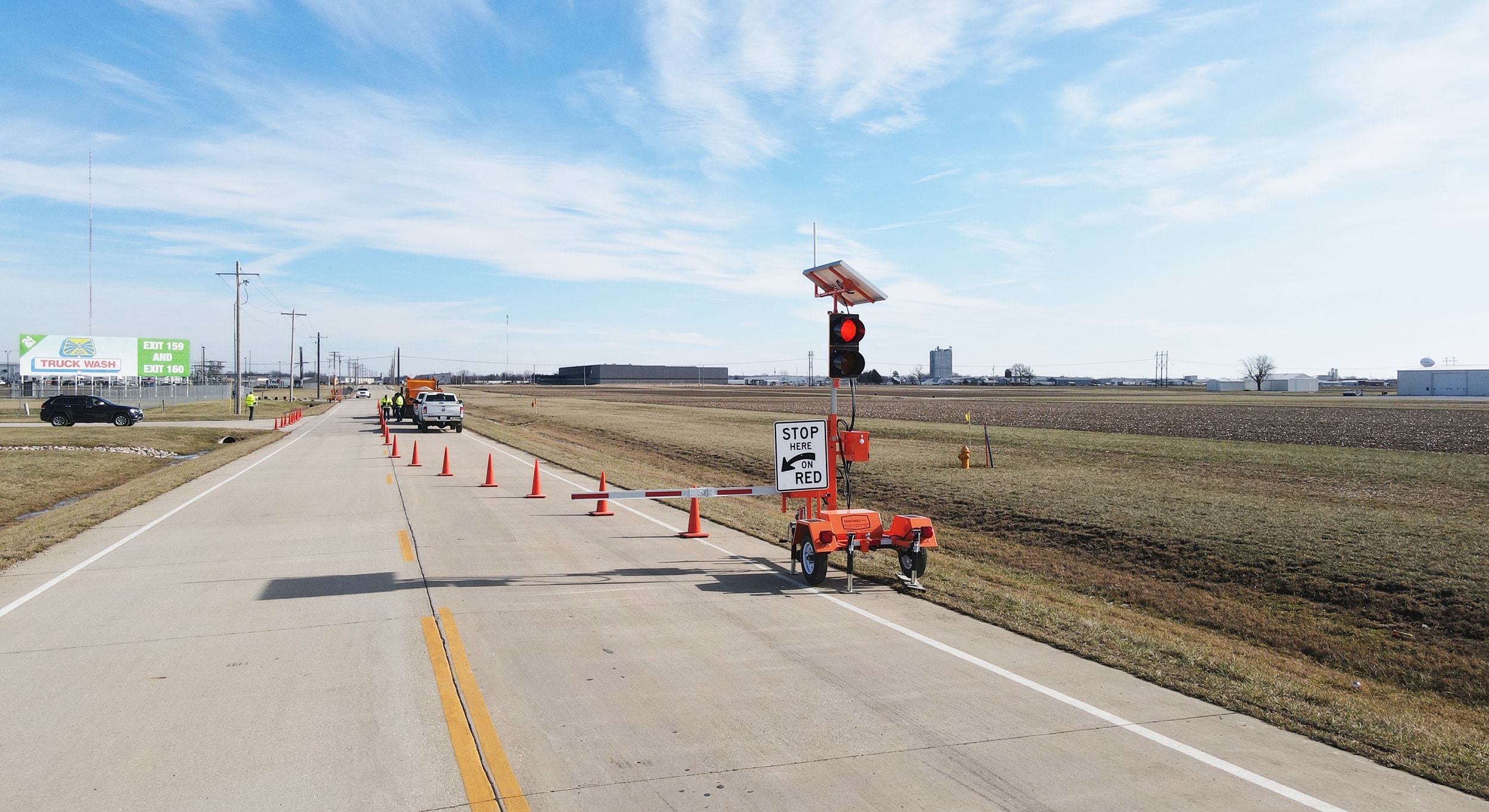
An automated flagger assistance device is a remotely controlled unit that shows drivers the stop and proceed indication at one end of a lane closure, while a human flagging crew puts a person at each end to direct traffic by hand. The traffic control task itself does not change. What changes is who stands where. With a device at each end, the operator works from a position away from the travel lane, and the crew picks up haul, siting and takedown work that a hand flagging operation never has. A trained flagger stays part of the operation either way [1].
Table of Contents
What is an automated flagger assistance device?
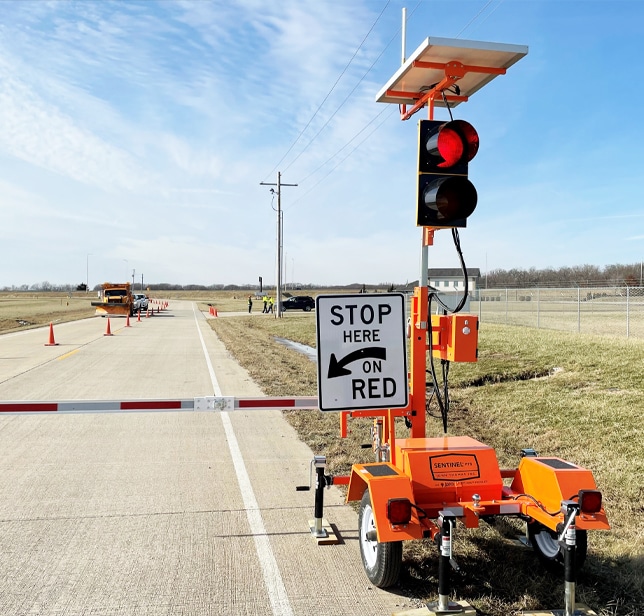
The category, automated flagger assistance devices, covers temporary traffic control equipment operated by remote, built around high visibility signing, a red and yellow signal indication and an automated gate arm that moves across the approach lane [1]. One device controls one direction of approaching traffic, so an alternating one way closure on a two lane road runs a device at each end.
Typical work is short and intermediate duration: bridge maintenance, haul road crossings, guardrail repair and pavement patching. Longer closures are a poorer fit and are usually held with a different control method [1].
What does the driver see at the approach?
A driver reads three things in sequence: advance signing, a signal head showing red or yellow, and a gate arm lowering across the lane. The arm is the only one of the three that physically occupies the lane.
Reported driver response has been consistent. Agencies running the devices in the field recorded few instances of confusion, with drivers reading the light and arm combination without difficulty [2]. In one field comparison against hand flagging, approach speeds fell by about four miles per hour and vehicles stopped roughly eleven feet farther back from the closure [3].
Who operates it?
A single operator has been reported running two devices at once, covering both ends of an alternating one way closure [2]. That is the honest answer to the staffing question, with one condition attached. The devices do not remove the need for a trained flagger on site, and someone has to be able to take an end by hand if a unit stops responding [1]. Confirm the operator arrangement for the specific equipment before planning a crew around it.
The device itself runs on a radio control unit or a cable connected directly to it [1]. The operator stands back from the running lane with a line of sight to the device and to the queue behind it, and holding that sight line is the part of the job that differs most from hand flagging.
How does a human flagging crew run the same work zone?
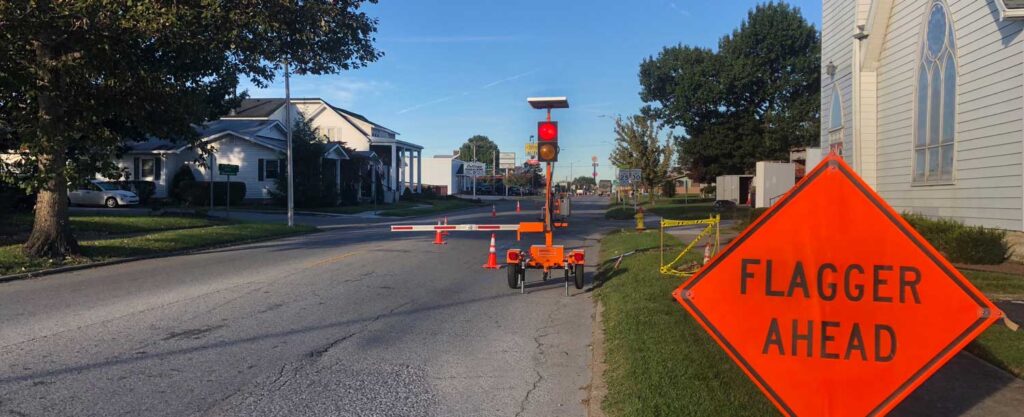
The two ends coordinate by radio, one holding while the other releases, and the whole operation runs on that radio discipline. A trained flagger stands at each end in view of traffic, working with a paddle and high visibility clothing, reading approaching vehicles continuously through the shift.
What it does well: a flagging crew adapts instantly. A flagger waves through an emergency vehicle, holds for a truck backing out of the site, reads the driver who is clearly not going to stop, and moves position as the work moves. None of that needs a setup change.
What it costs: two people are committed to the ends for the whole shift, both standing in or beside the travel lane, and the quality of the operation tracks their concentration.
Automated flagger vs human flagger: what actually changes on site?
Four things change: how long setup and takedown take, where the crew stands, how the two ends stay coordinated, and how consistent the message holds across a shift. Everything the closure has to achieve stays the same.
| On site | Human flagging crew | Automated flagger assistance device |
|---|---|---|
| Position at the ends | One flagger per end, in view of traffic | Operator positioned off the roadway [1][2] |
| Setup | Signs and personnel | Units hauled, positioned and sighted, needs shoulder and lane width [2] |
| Coordination | Radio between two people | Control link from operator to device [1] |
| Adapting mid shift | Immediate, no setup change | Requires repositioning the units |
| Across a long shift | Tracks operator concentration | Consistent indication, monitored |
How does setup and takedown differ?
Hand flagging sets up with signs and people. Device deployment adds a haul and a siting step. The units have to reach the site on a vehicle that can carry them, get positioned where the approach works, and come back off the same way at the end of the job [2].
That is a fixed cost per deployment. On a closure running for days it disappears into the schedule. On a two hour repair it can be most of the job, which is the practical reason short duration and constantly moving work often stays with a hand crew.
Where does the crew stand?
This is the difference a safety manager weighs first. Hand flagging places a person at each end facing live traffic for the length of the shift. With devices in place, the operator works from a position away from the travel lane while keeping the units in sight [1][2].
The exposure behind that decision is not small. Between 2011 and 2022 there were 1,462 fatal occupational injuries at road construction sites, and 44 percent of them involved a worker struck by a vehicle in a work zone [4]. Moving one worker back from the lane edge does not make a work zone safe on its own, and the crew inside the closure is exposed either way, but it takes a person out of one of the positions where exposure runs highest.
What happens across a long shift?
A signal head and gate arm present the same indication at hour nine as at hour one. A person does not, and night work is where that shows first. Agencies reporting on their own deployments singled out night operations as the case where the devices were preferred, because worker visibility is the thing that degrades [2].
The trade is responsiveness. A device holds a consistent message and gives up the judgement a flagger applies to an unusual approach. The operator’s attention moves from directing traffic to watching the queue, the work area and the units.
When is a human flagger still the better choice?
Short duration work is the clearest case. When haul, siting and takedown run longer than the task itself, a hand crew is set up and working before the units are in position. Naming the rest of these matters more than another benefits list, because a wrong deployment creates more problems than the equipment solves. Site selection is the step experienced crews plan first [5].
- Work that moves continuously along a route, since every move means repositioning the units
- Complex intersections and multiple approaches, because a device controls one direction of approaching traffic at a time [1]
- Sites where the approach sight distance to the device cannot be established
- Shoulder or lane width too narrow to place a unit clear of the travel lane [2]
- Work needing constant judgement calls, such as heavy truck movements in and out of the site, emergency access or frequent pedestrian movement
There is also a third option in the middle. A pair of portable traffic signals holds an alternating one way closure without a person at either end and suits longer closures better than either flagging method.
What should you ask before choosing for your work zone?
Work through these against the site in front of you. They settle the question faster than any comparison table.
- How long will the closure run, and does deployment time fit inside that?
- Does the geometry give a clear sight line from the operator position to both units?
- Is there shoulder and lane width to place a unit clear of the travel lane?
- How long is the shift, and how much of it falls at night or in poor visibility?
- What is the power and runtime requirement, and how does a unit get recharged or refuelled between shifts?
- How is the site secured overnight, and can units be left in place?
- Is this recurring work or a single project?
On the last one, if the schedule points at a single project, the option to rent portable traffic signals covers the same question on the signal side.
Where do AFADs fit in the JTI range?
JTI engineers and manufactures in house, with USA-MADE construction, and lists three products in this category: AFADs, the Sentinel AFAD and the Scout AFAD. The company has delivered traffic control and roadway safety solutions for more than 25 years. Current configurations and product detail sit on the AFAD product range page.
For a question this article does not answer about a specific site, talk to the JTI support team on 888.447.7263, backed by 24/7 expert support.
Key Takeaways
- A device moves the operator off the travel lane, it does not empty the work zone, and a trained flagger stays part of the operation
- A single operator has been reported running two devices at once on an alternating one way closure, which is the real staffing difference
- Haul, siting and takedown are the fixed cost per deployment, which is why short and constantly moving work often stays with a hand crew
- Devices need approach sight distance and shoulder width, and sites that cannot provide either remain flagging crew sites
- Night work and long shifts are where a consistent indication earns its place
References
Agency guidance and field reports
[1] Federal Highway Administration, Office of Operations. Automated Flagger Assistance Devices, Fall 2017.
[2] Washington State Department of Transportation. Report to the Legislature on the Use of Automated Flagger Assistance Devices, February 2011.
[3] Missouri Department of Transportation and the University of Missouri. Evaluation of Automated Flagger Assistance Devices, February 2018.
Worker safety data and technical guidance
[4] National Institute for Occupational Safety and Health. Internal Traffic Control Plans and Work Zone Struck By Fatalities, April 2024.
[5] American Traffic Safety Services Association. Use of Automated Flagger Assistance Devices, 2025 update.