

Intro
Contractors in Illinois do not lose money on traffic control because they lack cones or signs, they lose money because the plan is incomplete, the setup is inconsistent, or the daily checks are not documented. A good Traffic Control Plan (TCP) is the difference between a lane closure that runs predictably and a lane closure that produces rework, delays, complaints, and safety exposure.
Temporary traffic control is not just a set of devices. It is a system for moving road users through or around work while protecting workers, responders, and the traveling public, including pedestrians and people with disabilities [1]. In Illinois, public owners also emphasize safety and mobility outcomes such as reducing serious crashes and minimizing delay impacts through the full project lifecycle [2].
This guide is written for contractors, supervisors, and jobsite leads who need a practical, repeatable process for building, setting, inspecting, changing, and closing out traffic control in a way that stands up in the field.
Table of Contents
Why a TCP matters for schedule, safety, and liability
Field reality: Traffic control is installed in live traffic, often under time pressure, weather changes, and shifting site constraints. The plan has to be executable by the crew that shows up at 5 a.m., not just “correct” in a design file.
Safety and mobility are tied together: The core temporary traffic control standard is built around continuity of movement, access, and protection through the work zone, from planning through completion [1]. Illinois policies reinforce that the intent is to address safety and mobility issues starting early and continuing through project completion, with goals tied to crash reduction and delay minimization [2].
Most disputes start with one of three gaps:
- The approved plan set does not match what is installed in the field, and there is no documented change control [6].
- Devices are installed, but not maintained, cleaned, or kept in correct position through the shift [1].
- A closure is requested or scheduled without a plan package that clearly defines limits, stages, and responsibilities, creating last-minute redesign in the field [12].
A TCP that includes clear responsibility, inspection routines, and change procedures reduces variability, which is the real driver of cost and risk.

What a compliant TCP should include
A TCP is often used as shorthand for the temporary traffic control plan referenced in federal requirements. For significant projects, the required Transportation Management Plan (TMP) includes a TTC plan and additional transportation operations and public information components; for less-than-significant impacts, the TMP may consist only of a TTC plan [6]. Either way, the TTC plan must be consistent with the temporary traffic control provisions in Part 6 [6][1].
A contractor-friendly TCP package should be organized so the field can run it without guessing. Use the checklist below as a content standard for submittals, pre-mobilization, and field binders.
Minimum TCP package content (practical):
| TCP package element | What it does in the field | What inspectors typically verify |
|---|---|---|
| Cover sheet with contacts, limits, and schedule | Makes responsibility and response time clear | Who owns the plan, who can approve changes, emergency contacts [6] |
| Stage-by-stage layout sheets | Prevents improvisation when stages shift | Installed devices match approved stage [6] |
| Typical applications or standard drawings referenced | Reduces design errors and speeds setup | Plan is consistent with Part 6 typical applications and principles [1][6] |
| Device schedule and quantities | Prevents under-stocking and substitutions | Device types present and appropriate for roadway context [1] |
| Sign legend and sign placement details | Reduces wrong sign, wrong sequence problems | Advance warning and regulatory signing is present and visible [1] |
| Taper approach, buffer, work space notes | Aligns crew placement with safe layout | Buffer and work space protected and consistent with layout intent [1] |
| Pedestrian and accessibility accommodation plan | Prevents unsafe or inaccessible detours | Accessible passage and detectable channelization where needed [1][13] |
| Inspection and maintenance procedure | Keeps the closure compliant after setup | Devices maintained, clean, and positioned as required [1] |
| Change control and as-built capture process | Avoids unapproved field redesign | Changes approved and documented before implementation [6] |
A useful mental model is that a TCP is both a drawing set and an operating procedure. If either piece is missing, you will pay for it later.
The traffic control plan checklist for Illinois crews and jobsite leads
This section is designed to be run as a field workflow. Use it as a pre-mobilization gate, a setup sequence, a daily inspection routine, a change control pathway, and a closeout checklist. Where an owner requires a formal approval step, treat that as a hard stop before field changes are implemented [6].
How to use it: Assign one accountable person for execution, one for verification, and one for documentation. Federal requirements also emphasize that the State and the contractor each designate a trained person with primary responsibility and authority for implementing the TMP and safety and mobility aspects [6].
Workflow overview (compact text chart):
Upstream planning -> Pre-mobilization -> Setup and verification -> Daily inspection and corrections -> Managed changes -> Closeout and restoration
Phase checklist table (high-level):
| Phase | Goal | Outputs you should have before moving on |
|---|---|---|
| Pre-mobilization | Prevent surprises in permits, staging, and devices | Approved plan set, device list, roles, schedule, contact plan [2][6][12] |
| Setup day | Install a closure that matches the approved stage | Installed devices verified, documented, and corrected before opening [1][6] |
| Daily operations | Keep devices effective, visible, and consistent | Inspection log, corrections completed, photo record as needed [1][14] |
| Change events | Update safely without creating noncompliance | Change request, approval record, updated layout, field confirmation [6] |
| Closeout | Remove confusion and restore normal conditions | Devices removed or covered, lanes restored, records saved [1] |
Pre-mobilization checklist (before the first cone goes down)
Permits and owner requirements: Confirm which roadway jurisdiction you are working under, which permit or closure request process applies, and what owner standards control the plan package and device quality expectations [2][12]. If you will work on facilities with additional manuals or closure request lead times, build those dates into your schedule rather than hoping the process will flex [12].
Plan set readiness: Verify the stage you will install first, the exact closure limits, and what triggers a stage change. Confirm detours, driveway access plans, pedestrian routing, and any temporary signal or flagging approach [1][6].
Roles and authority: Assign a trained traffic control lead with authority to stop work, correct devices, and request approvals for changes [6]. Ensure the chain of command is written on the cover sheet and shared with the foreman and crew.
Device compliance documentation: For work zone devices that require crashworthiness documentation, ensure the required self-certification or eligibility letters are available as required, and confirm device categories and applicable requirements for the letting timeline [13]. Do not wait until an inspector asks.
Inventory and condition gate: Stage and inspect devices before deployment. For agencies that use device quality standards, treat device condition as pass or fail, not “good enough” [11]. Clean lenses and retroreflective surfaces, replace broken bases, and remove any device that cannot hold position in wind or traffic blast.
Training and briefing: Conduct a short pre-task briefing that covers the sequence of placement, roles for spotting, escape paths, radio calls, and the correction process if devices drift or traffic behavior is unsafe [1][14].
Setup checklist (installation sequence and verification)
Install in a safe order: Build the work zone from upstream to downstream so the crew is protected by what is already installed. Temporary traffic control zones are typically organized into an advance warning area, transition area, activity area, and termination area, and the layout and devices should be selected based on roadway type, conditions, duration, and proximity to traffic [1].
Verify visibility and placement: Confirm devices are upright, aligned, and visible. Confirm that signs face oncoming traffic correctly, are stable, and are not blocked by vegetation or parked equipment [1].
Confirm accessibility: If pedestrians are present, confirm the alternate route is continuous and accessible, and that detectable pedestrian channelizing features are used where required [1][13].
Verify upstream protection where required: Where workers are exposed near live lanes, consider whether positive protective measures are required by contract, policy, or project conditions. Illinois policies include guidance on when positive protective devices must be considered and when they are required based on work conditions and risk [4]. Treat this as a planning and staging decision, not a field improvisation.
Document the baseline: Take a short “as-installed” photo set or layout confirmation record and log the time the closure became active. Baseline documentation makes later change control and claims handling far easier [6][14].
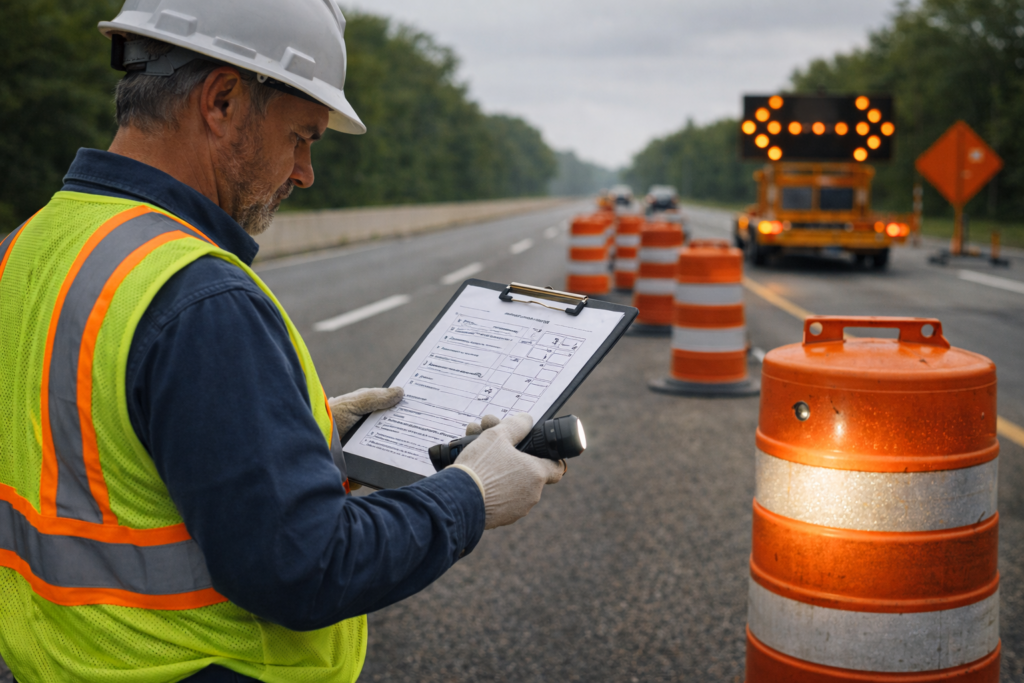
Daily inspection checklist (keep it compliant through the shift)
A closure that was perfect at 7 a.m. can be noncompliant by 10 a.m. due to traffic blast, wind, maintenance access, or a delivery truck moving devices. Part 6 emphasizes maintenance of safe and continuous passage and the need to keep devices effective for road users, workers, and responders [1]. Quality assurance checklists also focus heavily on whether devices are installed per plan and maintained clean and in proper position [14].
Use a daily inspection routine that is repeatable and documented.
Daily walk-through:
- Advance warning devices present and visible, no missing or turned signs [1][14]
- Channelizing devices aligned and not drifting into lanes or the work space [1]
- Taper intact, no gaps that invite early merges or lane straddling [1]
- Buffer and work space still protected, no equipment staged in unsafe locations [1]
- Pedestrian route intact and accessible, no pinch points or missing detectable guidance [1][13]
- Lighting and warning lights functional for low visibility conditions where used [1][14]
- Upstream protection positioned as planned and adjusted to field conditions [4][14]
Document and correct: Log findings, correct issues promptly, and record corrective action. If a correction requires a plan change, follow the change control steps below [6].
Suggested daily log fields (quick template):
| Field | Example entries |
|---|---|
| Inspector | Name, role |
| Date and time | Start and end of inspection |
| Stage active | Stage ID and limits |
| Weather and visibility | Clear, rain, fog, dusk |
| Issues found | Missing sign, shifted drums, blocked pedestrian path |
| Corrective actions | Replaced device, re-aligned taper, updated pedestrian routing |
| Photos | Yes or no, file names or storage location |
Plan content that keeps inspectors, owners, and crews aligned
A contractor can install what the plan shows, but if the plan is missing key details, the field is forced to invent solutions. That is where problems start.
Clarity beats complexity: Part 6 explains that no single set of devices can satisfy all conditions and that typical applications depict common use, with selection based on road type, conditions, duration, and constraints [1]. Your plan should show what is typical and clearly document what is intentionally different.
After the first paragraph in this section, it helps to break the content into the decision points that actually matter in the field.
Road users and access (vehicles, pedestrians, bikes, property)
The temporary traffic control standard explicitly includes motorists, bicyclists, pedestrians, and persons with disabilities, and emphasizes continuity of movement and accessible passage [1]. If your plan does not address non-motorized access, crews will either block it or improvise, and both outcomes are risky.
Use a dedicated plan callout for:
- Pedestrian detours and crossings
- Driveway and business access
- Transit stops or school routes if applicable
- Night conditions and visibility constraints [1]
Device compliance and submittal documentation
Illinois contract documents may require specific documentation for devices such as temporary sign supports and other crashworthiness-sensitive devices, including eligibility letters or self-certification depending on device category [13]. Build this into your submittal package and field binder so the project does not stall when documentation is requested.
Operations, public information, and incident readiness
For significant projects, federal requirements define that the TMP includes not only a TTC plan but also transportation operations and public information components, and encourages sustained consultation with stakeholders such as emergency services, schools, businesses, and others [6]. Even on smaller projects, the same thinking helps contractors reduce surprises, especially around emergency access and changes to traffic patterns.
Setup sequence: how to install without creating upstream risk
Sequence matters because exposure grows with time: The longer your crew is installing a closure without upstream control, the more exposure you create. Install from upstream to downstream, verifying each part as you build it, aligning with the typical work zone structure described in Part 6 [1].
Compact setup flow (field cue card style):
- Establish upstream approach protection and staging
- Install advance warning devices in correct order
- Build the transition taper
- Establish buffer and work space separation
- Install downstream termination and return-to-normal devices
- Walk back through the full closure and correct
Two practical checks that prevent 80 percent of rework:
- Sightline check: Walk the approach like a driver and confirm the intended message is visible early enough to act, especially where curves, hills, or roadside clutter exist [1].
- Consistency check: Confirm devices are uniform in spacing and alignment through the taper, because visual inconsistency leads to late merges and erratic behavior [1].
If the closure is on a facility that has a formal closure request or communications procedure, verify the closure matches what was requested and authorized before activation [12].
Managing changes without losing control of compliance
Change triggers happen every day: Weather shifts, deliveries arrive, a stage finishes early, a driveway access conflict appears, or an inspector requests a correction. The question is not whether changes happen, it is whether changes are managed.
Federal requirements for project-level procedures emphasize that contractor-developed plans are subject to owner approval and shall not be implemented before approval [6]. Treat that principle as your default unless the contract explicitly allows field adjustments under defined limits.
Change control checklist (fast and usable):
- Identify what changed and why (staging, hazard, access, crash, weather, schedule)
- Determine whether the change affects traffic patterns, pedestrian routes, device type, or closure limits
- Capture a quick marked-up layout of the change
- Obtain the required approval based on contract and jurisdiction [6][12]
- Implement the change with the same upstream-to-downstream discipline as initial setup [1]
- Document the updated baseline (photos or notes), then resume daily inspection cadence [14]
Common mistake: “Temporary” changes that stay in place for days without a revised plan record. This creates compliance exposure and claims risk because the installed condition no longer matches the approved condition [6].
Inspection readiness: what reviewers usually look for
The simplest question inspectors ask: Is what is installed consistent with the approved plan and the governing temporary traffic control standard? Federal guidance materials provide checklists that focus on device installation, maintenance, training and designation of traffic control personnel, nighttime effectiveness, and the condition of devices and operations [14].
A practical way to stay ready is to run a weekly “deep inspection” in addition to daily checks.
Weekly deep inspection focus areas:
- Nighttime visibility and glare issues (especially if portable lighting is used) [14]
- Device cleanliness and retroreflective condition [14]
- Confirmation that devices not needed are removed or covered so they do not confuse drivers [1][14]
- Verification of pedestrian routing, especially after grading or staging changes [1][13]
- Confirmation that trained responsible persons remain assigned and available [6]
Device quality: keeping the line looking professional and performing correctly
Device condition is not cosmetic: Dirty, damaged, or inconsistent devices reduce comprehension and can change driver behavior. Some Illinois-area owner standards define device quality expectations and may classify devices by condition categories such as acceptable, marginal, and unacceptable, which supports objective replacement decisions [11].
Practical device condition checks:
- Upright, stable, and not leaning into the travel way
- Retroreflective surfaces clean and intact
- Bases intact with no exposed sharp edges
- Lights functioning where required and appropriately aimed
- No improvised attachments that change crashworthiness category or stability [13]
For projects with contract language tied to crashworthiness categories and documentation, avoid substitutions that create a documentation gap. The better practice is to stage compliant spares and swap immediately when a device fails [13].

Closeout and restoration: ending the shift without leaving hazards
Closeout is part of temporary traffic control, not an afterthought: Part 6 emphasizes continuity and avoiding unexpected conditions for road users [1]. Leaving devices in place when they are not needed creates driver confusion and can increase risk.
Closeout checklist:
- Remove devices that are no longer needed, or cover them if removal is not feasible for the shift [1][14]
- Restore normal lane configuration and confirm roadway is clear of equipment and debris
- Confirm temporary pedestrian routing is either removed or remains safe and accessible if the closure persists [1][13]
- Update logs and capture any deviations or unresolved issues for the next shift
- Confirm closure status and communications per the facility process if required [12]
Closeout discipline protects tomorrow’s setup: A clean closeout reduces the chance that the next crew starts with a noncompliant baseline.
Common mistakes that cause rework, delay, and complaints
Use this list as a “pre-mistake check” during planning and daily inspections.
- Missing authority: No trained person on site with authority to correct devices and manage changes [6].
- Unmanaged changes: Field changes implemented without approval where approval is required [6].
- Accessibility gaps: Pedestrian routing broken, inaccessible, or not detectable where needed [1][13].
- Device substitutions: Devices swapped without understanding crashworthiness documentation requirements [13].
- Poor maintenance: Devices not kept clean, upright, and in proper position, especially after wind or traffic blast [1][14].
- Leaving devices up: Temporary devices left in place when work is inactive, creating confusion [1][14].
- No baseline documentation: No record of what was installed at activation, making disputes hard to resolve [14].
One-page field template you can standardize across projects
Purpose: Give your superintendent, foreman, and inspector one page that drives consistent execution. This does not replace plan sheets, it supports them.
One-page TCP field sheet content:
- Project name, route, limits, stage ID
- Dates and closure window
- Responsible persons and contact numbers [6]
- Device quantities staged and installed
- Setup sequence confirmation (checkboxes)
- Pedestrian route confirmation (checkbox)
- Upstream protection confirmation (checkbox, as applicable) [4]
- Daily inspection log fields (time, issues, corrections)
- Change log fields (what changed, approval, implemented time) [6]
- Closeout confirmation (devices removed or covered) [1]
If you standardize this sheet and require it on every closure, your crew performance becomes repeatable, and repeatability is what produces cost control.
Key Takeaways
- A TCP should function as both a drawing set and a field operating procedure, aligned to Part 6 principles for all road users [1].
- Federal requirements tie TTC planning to a TMP framework, approval controls, and trained responsible persons on both the owner and contractor side [6].
- Pre-mobilization and setup sequencing reduce exposure and rework, especially when closures must match facility-specific processes [12].
- Daily inspections plus clear documentation keep devices effective and help manage drift, visibility issues, and accessibility needs [14][13].
- Change control and clean closeout prevent “plan versus field” gaps that trigger compliance exposure and driver confusion [6][1].
References
Core Standards and National Requirements
[1] “MUTCD 11th Edition, Part 6 Temporary Traffic Control,” Federal Highway Administration, December 2023 [PDF].
[5] “Regulation and Policy – FHWA Work Zone,” Federal Highway Administration, accessed January 2026.
[6] “23 CFR § 630.1012 – Project-level procedures,” Legal Information Institute, Cornell Law School, current as of 89 FR 87293 (November 1, 2024).
[7] “Implementing the Rule on Work Zone Safety and Mobility (23 CFR 630 Subpart J),” Federal Highway Administration, September 2005.
Illinois DOT Policies and Contractor Resources
[2] “Traffic Control,” Illinois Department of Transportation, accessed January 2026.
[3] “Work Zone Safety Materials,” Illinois Department of Transportation, accessed January 2026.
[4] “Work Zone Safety and Mobility Supplemental Policy, Positive Protection of Workers, Drop-offs and Temporary Concrete Barrier: 4-21,” Illinois Department of Transportation, revised November 8, 2021 [PDF].
[13] “Special Provision for Work Zone Traffic Control Devices,” Illinois Department of Transportation, September 26, 2025 (revised January 1, 2026) [PDF].
Inspection and Quality Assurance Checklists
[14] “Sharing Work Zone Effective Practices for Design-Build Projects: Chapter 5 Quality Assurance Checklists for Work Zones in Design-Build Projects,” Federal Highway Administration, accessed January 2026.
Illinois Toll Facility Manuals and Quality Standards
[12] “Roadway Traffic Control and Communications Manual,” Illinois Tollway, March 2025 [PDF].
[11] “Quality Standard for Work Zone Traffic Control Devices,” Illinois Tollway, March 2023 [PDF].