
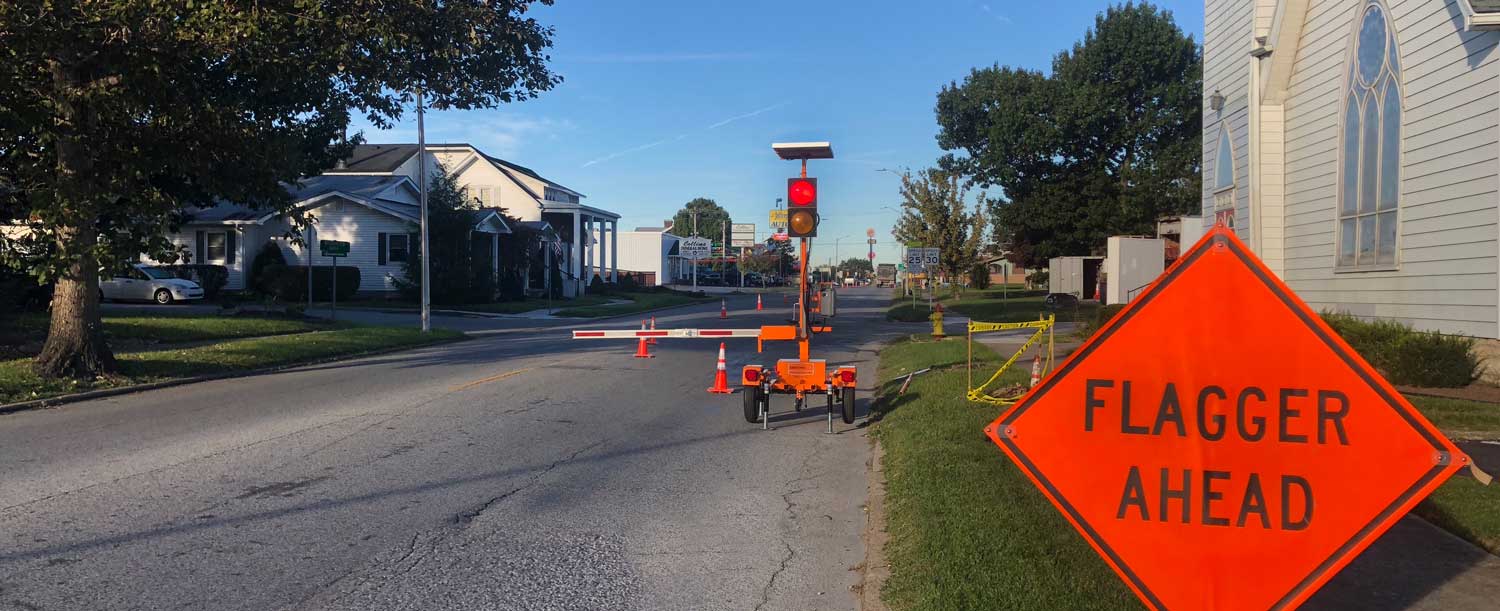
If you are shopping for an automated flagger for sale, five things separate one unit from another: power and runtime, operator control and range, how long deployment and takedown take, how the unit moves between work areas, and whether it reports its own status. Everything else is packaging. Buying well means getting answers on those five in writing before the order goes in.
This guide assumes the approach decision is already made. If you are still weighing it, start with how an automated flagger compares with a human flagging crew and come back. What follows is a checklist that works at any manufacturer, not only this one.
On where to buy, this is specialist equipment rather than general plant, so the shortlist is short either way. What matters is less the day of purchase than two years later, when a part fails and somebody has to have it on a shelf, so weigh parts availability and the service path alongside the unit itself.
Table of Contents
What are you actually buying?
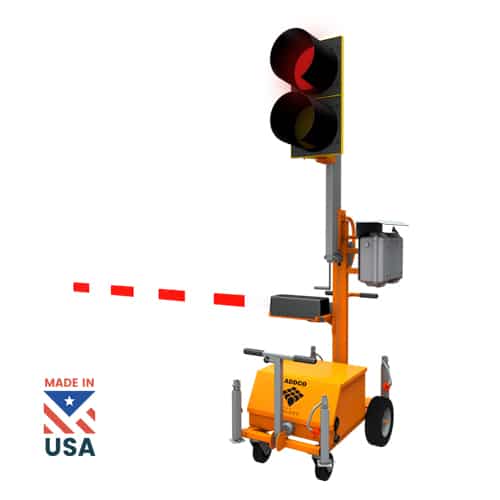
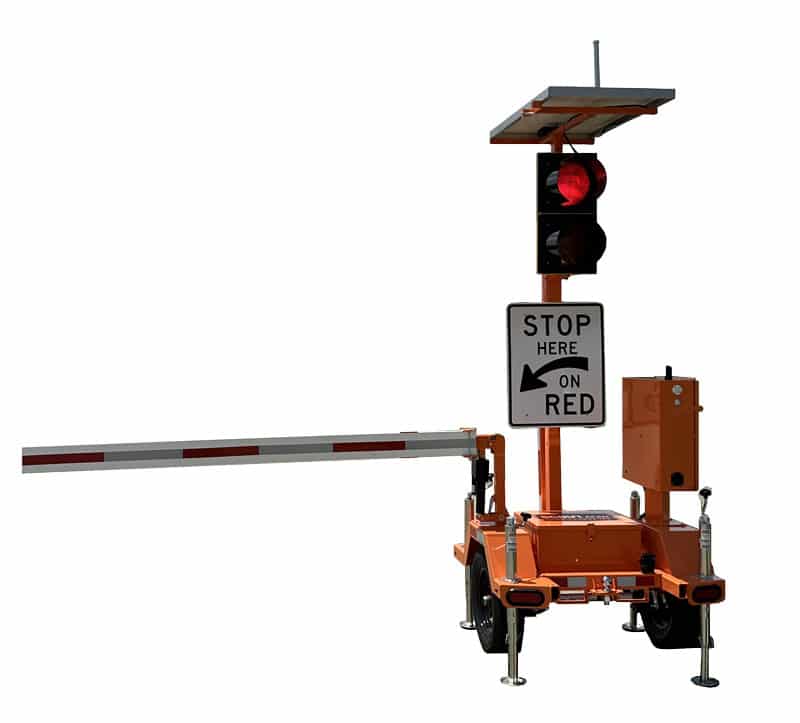
A unit is six parts bolted to a base, and knowing what each one does makes the specification questions later obvious rather than technical. The category, automated flagger assistance devices, covers remotely operated equipment built around signing, a signal indication and an automated gate arm [1].
Gate arm: the arm that lowers across the approach lane. It is the only part of the unit that physically occupies the lane, and it is what an inattentive driver registers first.
Signal head: the red and yellow indication that tells the approaching driver to stop or prepare to move [1].
Signing: fixed signing mounted to the unit, typically instructing the driver where to stop in relation to the arm.
Operator control: the handheld or cabled control the flagger uses to change the indication [1]. This is the part that varies most between manufacturers.
Power source: what runs the signal, the arm motor and the control link through a full shift, and how it recharges between shifts.
Base: wheeled or trailer mounted, which decides how the unit gets to site and how quickly it can be repositioned.
Automated flagger for sale: which specifications decide whether a unit fits the work?
These are the five that change the answer. Everything else on a spec sheet is detail around them.
- Power and runtime, measured against your longest shift and not a nominal figure
- Operator control method and working range, and the behavior when the link drops
- Deployment and takedown time, and how many people it takes
- Transport, meaning what tows or carries the unit and how fast it repositions
- Status reporting, meaning whether the unit tells you what it is doing without someone walking to it
How long will it run on a shift?
Ask what the unit draws with the arm cycling at the rate your work actually produces, not what it draws idle. A gate arm that moves twice a minute on a busy approach is a different load from one that moves twice an hour on a rural repair, and runtime claims can be quoted against the gentler case.
Then ask what happens at the end of a long shift and what recharging looks like between shifts. Night work and short winter days are where this matters most, because the demand goes up at the same time the recovery window gets shorter. Get the answer as a range tied to a duty cycle you recognize.
How is it commanded, and how far?
The unit is run by a trained flagger using a radio control or a cable connected directly to it [1]. The question to put to a manufacturer is what working range you get in the conditions you actually work in, because a clear line of sight across open ground and a sight line through a curve or a tree line are not the same test.
Then ask the awkward one: what the unit does when the control link drops. Check whether the operator can see that it has dropped, and how the end gets covered by hand while it is sorted out. A device does not remove the need for a trained flagger on site, so somebody has to be able to take the end manually, and that is an operational question before it is a technical one [1].
How long does deployment and takedown take?
This is the number that decides whether the equipment suits short jobs. Deployment adds a haul and a siting step that a hand flagging operation does not have, and the units need to reach the site on a vehicle that can carry them and get positioned where the approach works [2]. On a closure running for days that cost disappears. On a two hour repair it can be most of the job.
Ask for a time with a crew size attached, because the two numbers are meaningless apart. The follow up is what the crew does by hand, what the unit does itself, and what the sequence looks like in the dark and in the wet.
How does it move between work areas?
Wheeled and trailer mounted bases behave differently, and the right answer depends on how often the work area moves. Get the towing and carrying arrangement for each configuration, the hitch and licensing situation for your vehicles, and the time it takes one crew to pick up, move and reposition a pair of units without opening the road to uncontrolled traffic in between.
Work that creeps along a route punishes a slow reposition more than anything else on this list. If that describes your jobs, make the manufacturer walk you through a move rather than quoting you a tow weight.
Does the unit report its own status?
On a spread out site nobody wants to walk a quarter mile to find out whether a unit is still powered. Establish whether the unit reports its own state, what it reports, and how that reaches the operator or the office. Where it is offered, this runs through a remote management system.
Then ask the follow up that matters more than the feature list: what it costs to run, whether there is an ongoing subscription, and whether the unit still functions normally if the reporting side is not subscribed or loses connectivity.
What should you confirm with the manufacturer before you order?
Ask these in writing. A manufacturer that answers them readily is telling you something useful about the two years after the sale.
- Are spare parts stocked, and which parts are the ones that actually fail?
- Where does a unit go for service, who pays to ship it, and what happens to the job while it is gone?
- Is operator training provided, in what form, and is it repeatable when crews turn over?
- What written documentation ships with the unit, and what else is available on request?
- What are the support hours and how is support reached outside them?
- What is the process when a unit goes down mid job?
- What is the warranty, and what voids it?
What an automated flagger costs: two quotes for the same category of equipment can differ substantially without either being wrong. The difference comes from configuration, base type, the power package, accessories, and what the support and training terms include, which is why a quote is only comparable once the answers above are sitting next to it.
On approvals: what a specifying agency will accept differs by agency, and it is not something a manufacturer can settle on your behalf. Confirm acceptance with the agency that owns the road before you order, not after. Site selection is a documented part of deployment planning, and acceptance belongs in the same conversation [3].
Should you buy or rent?
Occasional and unpredictable work rarely justifies owning. That is the short version, and the rest is an operating question rather than an equipment question, answered against how your work actually comes in.
- How long do the jobs run? Long closures favor owning, short scattered ones favor renting
- Is the work seasonal, and what does the unit do in the off months?
- Who maintains it, stores it, and keeps it charged between jobs?
- Who absorbs downtime when a unit is out of service, you or the supplier?
- Have you run the equipment on a live job before committing a fleet purchase?
That last one is worth more than the rest combined. A trial on real work answers the runtime, reposition and crew time questions in a way no specification sheet will. On the signal side, the option to rent portable traffic signals covers the equivalent question. For what is available to rent in any other category, talk to the JTI support team rather than assuming.
Where do AFADs fit in the JTI range?
JTI engineers and manufactures in house, with USA-MADE construction, and lists three products in this category: AFADs, the Sentinel AFAD and the Scout AFAD. The company has delivered traffic control and roadway safety solutions for more than 25 years, and supports what it builds with per product field assistance pages, an RMA process and 24/7 expert support. Configurations and current product detail sit on the AFAD product range page.
To put the questions in this article to a person rather than a spec sheet, talk to the JTI support team on 888.447.7263.
Key Takeaways
- Five specifications genuinely differ between units: power and runtime, control method and range, deployment time, transport, and status reporting
- Runtime is quoted against a duty cycle, so ask for it against yours rather than against a nominal figure
- Ask what the unit does when the control link drops, and who covers the end by hand while it is sorted
- A deployment time without a crew size attached is not a number you can use
- Quotes differ on configuration, base type, power package, accessories and support terms, so compare them only once those answers sit alongside
- Acceptance differs by agency, so confirm it with the agency that owns the road before ordering
References
Agency and industry technical guidance
[1] Federal Highway Administration, Office of Operations. Automated Flagger Assistance Devices, Fall 2017.
[2] Washington State Department of Transportation. Report to the Legislature on the Use of Automated Flagger Assistance Devices, February 2011.
[3] American Traffic Safety Services Association. Use of Automated Flagger Assistance Devices, 2025 update.